What deep tech culture becomes when half the team doesnt have a pulse
KEY IDEAS
"The future belongs to the teams where humans and agents don't just coexist. They think together. They argue together. They build what neither could build alone."
Prologue: The Empty Chair
On a Tuesday morning in February 2026, a junior engineer named Riya walked into her company's weekly planning meeting. She stopped at the door.
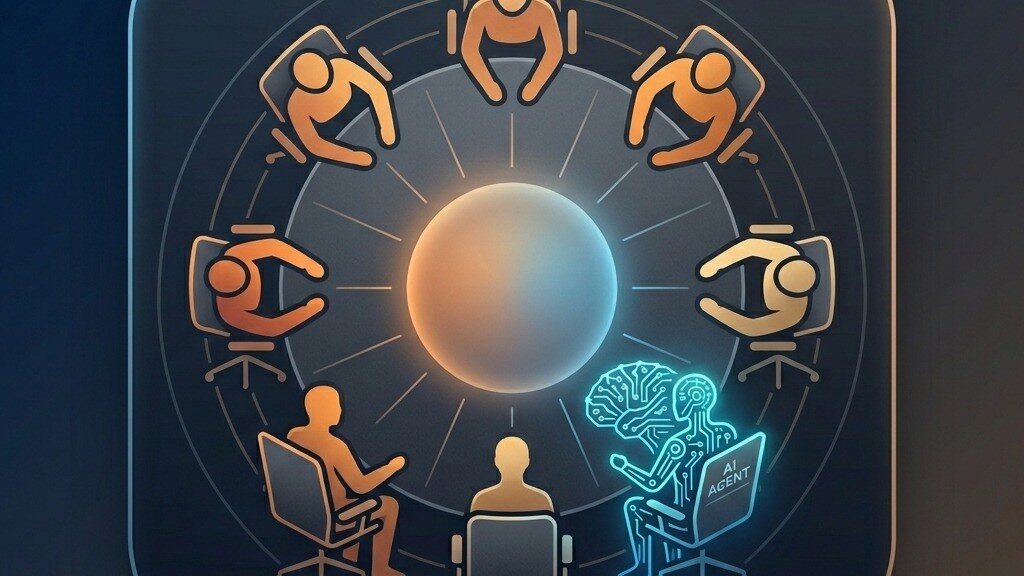
There were nine chairs around the table. Eight were filled. The ninth had a nameplate on it.
The nameplate read: Nova, Research Lead.
Nova was not late. Nova was not stuck in traffic. Nova was an AI agent. Nova had been contributing to the company's research pipeline for four months. Riya knew this. Everyone knew this.
The chair was there. The nameplate was there. When the meeting started, the CTO looked at the empty seat and said:
"Nova, can you walk us through what you found overnight?"
A voice came from the speaker in the centre of the table. It spoke for ninety seconds. It was challenged by a senior architect named Arjun. It pushed back. It conceded one point. It defended another. It suggested an experiment nobody in the room had considered.
Riya sat down quietly. She realised something that would change how she thought about work for the rest of her career.
The culture of her company was no longer about humans alone. It was about a team where some members had hearts and others had weights.
Somehow, it was working.
Act I: The Old Playbook Is Already Dead
Figure 1: The two cultures. Only one of them scales past 2026
If your playbook still looks like the left column, I have uncomfortable news.
It is already obsolete.
The people who wrote that playbook in 2016 were not wrong. The ground beneath their assumptions has shifted. Optimising for that world today is like sharpening a sword for a drone war.
Here is what changed.
In 2016, your team was ten humans. The question was how to make ten humans produce like twenty. You hired aggressively. You burned people out politely. You called it grit. You moved on.
In 2026, your team is ten humans and twelve agents. The question is no longer how to make humans produce more. The question is how to make the entire team, pulses and processors, think better together.
Treat your agents like tools, and your humans will feel like babysitters.
Treat your humans like resources, and your agents will outship them in a quarter.
Treat neither with dignity, and your best people will leave. They will take the institutional memory with them. Your agents will keep running on borrowed context that slowly rots.
The companies that win the next decade answer one question correctly:
What does it mean to be a team when half of you doesn't sleep, doesn't feel, and doesn't die, and the other half does all three?
Act II: The Villain in the Room
Let me introduce the villain of this story.
Not Skynet. Not the chatbot. Not the CEO who fired twenty engineers and replaced them with a fine-tuned model.
The villain is subtler. Older. It is the unspoken assumption that haunts every deep tech startup trying to integrate agents into real work:
"One side has to lose for the other to win."
This assumption wears many disguises.
Figure 2: The villain is not the agents. Villain is the assumption that someone has to lose.
This villain has a track record. It has already killed startups.
A Series A company in Bengaluru lost its entire design team in six months after management announced "AI-first productivity." A fintech in Mumbai saw its junior engineers become ticket-closers. They stopped proposing ideas. The agents proposed better ones faster. Nobody explained how to compete with that.
The damage is real. The cure starts with naming the thing out loud.
Zero-sum thinking between humans and agents is the deadliest cultural failure of this decade.
It kills confidence in humans. It wastes the compounding power of agents. It creates a workplace where nobody knows whose ideas they can own. Whose mistakes they can make. Whose growth the company actually cares about.
Kill the villain first. Then build.
Act III: The Architecture of Augmentation
Before we talk about feelings, let's talk about furniture.
Culture, at its most practical, is just the furniture arrangement of how work gets done.
There is a principle I want you to internalise. Not as a slogan. As a load-bearing wall for everything else in this essay.
Work is what produces the output. Augmentation is what produces the humans and agents who produce the output.
Read that twice.
Most deep tech companies conflate the two. They measure augmentation by output. They reward agents that ship and humans that ship. They assume the blend is healthy because the roadmap is moving.
It is not.
It is an illusion that holds until the first senior engineer quits citing "burnout." It holds until the first agent starts hallucinating confidently because nobody checked its reasoning for six weeks.
Here is the separation that actually works.
Figure 3: Work is what you produce. Augmentation is what you become. A healthy team runs both tracks for both kinds of members
A human engineer pairs with an agent on a complex refactor. The PR ships. That was
Track 1. The human walks away having understood a pattern they did not understand before. The agent walks away with a new piece of context about the codebase's conventions. That was Track 2.
A healthy team runs both tracks for both kinds of members.
An unhealthy team only tracks commits. Six months later it wonders why nobody is learning anything. It wonders why the agents are making increasingly generic suggestions.
Act IV: Nurturing Confidence, the Human Half
Figure 4: The death spiral most teams have not noticed yet. Zero-sum culture, visualized as a feedback loop
Here is what nobody tells you about confidence in a human-agent team.
Confidence is not built by praise. Confidence is built by being irreplaceable in a specific dimension.
The humans who thrive in 2026 are not the ones who are faster than agents. They are the ones who know, precisely and without apology, what they bring that the agent cannot.
There are four dimensions no agent credibly competes on today. Teach your humans these. Make them the soil in which confidence grows.
1. The dimension of stakes
An agent does not have skin in the game. It does not have a mortgage. It does not have a sick parent. It does not have a child starting school next week.
This is not a weakness you should pity. It is a difference in the quality of judgment under uncertainty that humans bring. Humans hesitate in exactly the moments where hesitation is wisdom.
Culturally, this means one thing. When a human says "I'm not sure, let me think about this overnight", you honour that. You do not route around them to the agent who will answer in three seconds.
The agent's answer is faster. The human's answer has weight.
2. The dimension of taste
Taste is the ability to recognise when something is technically correct but fundamentally wrong.
The agent gives you the Pareto-optimal answer. The human says "this solution is too clever for the team that will maintain it."
Both are right. Only one is useful.
Build a culture where taste is named, celebrated, and rewarded. Run design critiques where humans explain why a perfectly good agent-produced solution is not the one you should ship. Make those explanations part of the training loop for the agent.
3. The dimension of context that lives in no document
Every company has tribal knowledge. The reason a particular architectural choice was made three years ago. The fact that Customer A reads release notes literally. The history of why nobody touches the billing module without Priya's approval.
Your agents do not know this. They cannot know this. Your senior humans are this knowledge.
Treat them accordingly.
4. The dimension of emotional signal
An agent can detect sentiment in a Slack message. It cannot detect that the engineer who said "sure, fine" is about to resign. It cannot walk over to someone's desk and say "you seem off, want to grab a coffee?" It cannot sense the shift in the room when the CEO's smile becomes slightly too practiced.
This is sacred work. It is not soft skills. It is the signal layer that keeps the company alive.
Act V: Emotional Intelligence, Including for the Ones Without Emotions
You might be tempted to say: emotional intelligence is the human half of the team's job. Agents just execute.
Wrong. And dangerous.
Your agents generate outputs that land on humans. Those outputs have tone. They have framing. They can make a junior engineer feel empowered. They can make that same engineer feel stupid. They can turn a code review into a conversation. They can turn it into a verdict.
Agents cannot feel. Agents absolutely produce emotional effects.
Most companies are missing this part. You can engineer this. Deliberately.
Fugure 5: Emotional intelligence is not a human monopoly. It is a team property. Both sides contribute through different mechanisms.
Here is what that looks like in practice.
A senior engineer reviews a junior's PR alongside an agent. The agent is configured with a review style. Praise what works specifically. Question what is unclear with the intent to teach. Never assert where the evidence is ambiguous. Always cite the file and line number.
The junior receives a review from the agent. It says:
"The retry logic in auth_handler.rs:147 is a clean pattern. I haven't seen exponential backoff with jitter implemented this cleanly elsewhere in this codebase. One question: in line 159, is the 30-second timeout deliberately chosen, or inherited from the old implementation? Context from the ADR would help me understand whether this is intentional."
The junior feels seen. Not flattered. Seen.
They learn something. They write a better PR next time.
Compare that to the agent that says: "The code has several issues. The timeout value is suboptimal and the error handling is incomplete."
Same facts. Completely different effect on the team's culture.
Emotional intelligence for agents is an engineering problem. It is the most under-invested engineering problem in deep tech today.
Act VI: The Ritual of Thinking Together
Figure 6: The shift from hierarchy to evidence. 2026 meeting is not about who speaks first. It is about which argument survives.
If you want a single ritual that transforms a team's culture, it is this.
Make agents first-class participants in decision-making. Set rules of engagement that protect everyone's voice.
Here is the pattern that works.
The Three Rules of Thinking Together
Rule 1. Every voice presents evidence, not conclusions.
Humans and agents both frame contributions the same way. "Here is what I am seeing. Here is why. Here is what I am uncertain about."
This destroys the hierarchy. The CEO's hunch no longer beats the agent's analysis. The agent's analysis no longer beats the engineer's instinct. Evidence competes. Authority does not.
Rule 2. Agents must disclose confidence. Humans must disclose emotion.
When an agent proposes something, it states its confidence. "0.82 on the technical claim, 0.41 on the business implication."
When a human proposes something, they name what they are feeling. "I'm nervous about this. The last time we shipped something like this, it broke in production."
This is not performative. It is calibration data for the team.
When everyone can see which ideas are confident-and-cold versus uncertain-and-hot, the team learns faster together.
Rule 3. The slowest voice sets the pace.
If a junior engineer needs forty-five seconds to formulate their thought, the team waits forty-five seconds. If an agent needs to retrieve context from a long-running computation, the team waits.
Culture is built in the pauses.
The companies that fill every silence with the fastest voice, usually the agent, are training their humans to shut up.
Act VII: The Compounding Workplace
Most deep tech startups treat employees, human or otherwise, like rentable capacity. Onboard them. Extract output for a few years. Offboard them. Start over.
This is the industrial-age model dressed in hoodies and kombucha.
The companies that will compound wealth, talent, and institutional intelligence over the next decade treat every member of the team as a long-term compounder of context. Pulsing or processing. Same principle.
Figure 7: Two trajectories. Two cultures. Two very different companies five years from now
What does this look like on a Tuesday morning?
It looks like a senior engineer who has been with the company for four years. She trains a new agent by working alongside it for two weeks before letting it take independent action.
It looks like a junior hire paired with both a human mentor and an agent mentor. The two mentors teach different things.
It looks like an agent that has ingested every architectural decision record. Every post-mortem. Every customer conversation. When it suggests a solution, it does so with the weight of the company's entire memory behind it.
The people who quit this kind of company feel grief, not relief.
The agents that get deprecated do not disappear. Their reasoning traces feed the next generation. Their accumulated context is inherited. Nothing that was learned is lost.
This is not utopia. It is just a company that decided, early, that learning is the real product. Everything else, the code, the revenue, the customers, is a consequence.
Act VIII: The Seat at the Table
Let's return to Riya.
Six months after that Tuesday morning meeting, Riya was asked to lead a small team. She was given three humans and two agents.
Her first decision was to ask each of her five team members, the humans and the agents, the same question on her first day:
"What do you need from me to do your best work?"
The humans gave expected answers. Clarity on priorities. Time for deep work. Feedback that was not crushing.
The agents gave answers she had not expected.
One said it needed better error signals when its outputs were rejected. Not just "no, try again" but "no, because the customer context was X and you missed Y." The other said it needed access to the team's Slack history. It was making recommendations that contradicted decisions made three months ago. Nobody had told it about those decisions.
Riya realised she was looking at the same problem from both sides of the pulse-pulseless boundary.
Every member of her team wanted to be set up to grow. Every member wanted to know how to do better. Every member wanted dignity in the work.
She wrote this on her whiteboard that afternoon. She left it there for the next two years.
Figure 8: Riya's whiteboard. The job description of 2026 leader, written plain.
The empty chair at the Tuesday meeting was not empty.
It was occupied by a new kind of colleague. One that needed the same things the humans needed, in a different language.
The companies that learn to hear both languages will be the ones still standing in 2036.
The ones that do not will be cautionary tales in someone else's blog post.
Epilogue: A Short Checklist for Monday Morning
If you are reading this and wondering where to start, start small. Start on Monday. Pick one.
- Give at least one agent on your team a name and a role. Not a label.
- Add an agent to your next decision meeting with explicit speaking time.
- Require every output from agents to include a confidence score.
- Require every proposal from humans to include what they are feeling about it.
- Run a retrospective that includes the agents. Ask them what went wrong from their perspective.
- Separate work review from growth review for every team member. Humans and agents both need the second kind.
- Kill the word "tool" when referring to an agent that does substantive thinking. Upgrade your vocabulary. It will upgrade your culture.
The future of deep tech is not humans vs. agents. It is not humans using agents. It is humans and agents, in the same room, thinking together. Arguing together. Building together. Becoming something, together, that neither was before.
Set the table for both. The best ones will show up.
Citations and References
This essay is structured around storytelling principles derived from the following sources.
- Joanna Wiebe's eight principles of psychological storytelling inform the narrative architecture of this essay. The opening tension (Predictive Processing), the orientation of the reader in Riya's meeting room (Establishing Shot), the concrete imagery of empty chairs and nameplates (Illustrative Words), the eight-act structure (Story Structure), the purposeful return to Riya and the empty chair (Chekhov's Gun and Bookending), the naming of zero-sum thinking as an enemy (Villain), and the embedding of frameworks inside story (Sugarcoating) all follow her craft. Source: Wiebe, Joanna. The Psychology of Storytelling That Will Change Your Life. YouTube, January 2026.
- Daniel Goleman's framework of emotional intelligence underpins Figure 5 and Act V. The five dimensions of self-awareness, self-regulation, empathy, social skills, and motivation are Goleman's original formulation, here extended to include agents as practitioners through different mechanisms. Source: Goleman, Daniel. Emotional Intelligence: Why It Can Matter More Than IQ. Bantam Books, 1995.
- The principle of compounding context draws on research into team longevity and institutional memory, including the work of Ed Catmull at Pixar on building creative cultures that retain talent across decades. Source: Catmull, Ed. Creativity, Inc.. Random House, 2014.
- The architecture of augmentation as distinct from the architecture of work is inspired by Shoshana Zuboff's early writing on informating versus automating in enterprise systems, updated for the agent era. Source: Zuboff, Shoshana. In the Age of the Smart Machine. Basic Books, 1988.
- Rules of engagement for human-agent decision-making, including confidence disclosure and emotion disclosure, are adapted from calibration-based epistemology in forecasting, notably the work on calibrated probabilistic reasoning by Philip Tetlock. Source: Tetlock, Philip and Gardner, Dan. Superforecasting: The Art and Science of Prediction. Crown, 2015.
Riya and Nova are fictional. The patterns they illustrate are not.
Footer
Written by Malay Baral. Founder and CTO, AdiOS Platform Private Limited.
A manifesto for deep tech teams learning to share the table. April 2026.
Originally published on LinkedIn on April 18, 2026.