
By Malay Baral, AdiOS Platform | July 2026
Across boardrooms in Mumbai, Bengaluru, Delhi, and Frankfurt, the same conversation is happening. A CTO presents an AI roadmap. The board approves the budget. The pilots run. And then, quietly, the results disappoint. Not because the models are bad, but because the model of deployment is broken.
The dominant paradigm of enterprise AI asks institutions to do something extraordinary. Send your most sensitive operational data to a foreign cloud server. Pay per token for the privilege. Trust that your intellectual property will not train the next model sold to your competitor.
This is not a hypothetical risk. It is the architectural reality of how cloud AI APIs work. And the enterprise world is waking up to it.
The Problem Nobody Wants to Name
The argument is not that AI models are ineffective. It is that the token-billing, cloud-inference model is structured to extract value from enterprises rather than create it for them. Every query you send is a lesson your vendor learns about your business. Every document you process enriches their training corpus. You pay for compute. They receive your institutional knowledge.
We call this the Hidden Wealth Tax: a systematic transfer of enterprise advantage from the institution that built it to the platform that processes it.
Enterprise Alpha: Your Secret Sauce
To understand why AdiOS exists, understand what is at stake. We use the term Enterprise Alpha for the totality of an institution's competitive advantage. The accumulated operational logic, proprietary data, clinical protocols, financial models, regulatory muscle memory, and institutional knowledge that took years, sometimes decades, to build.
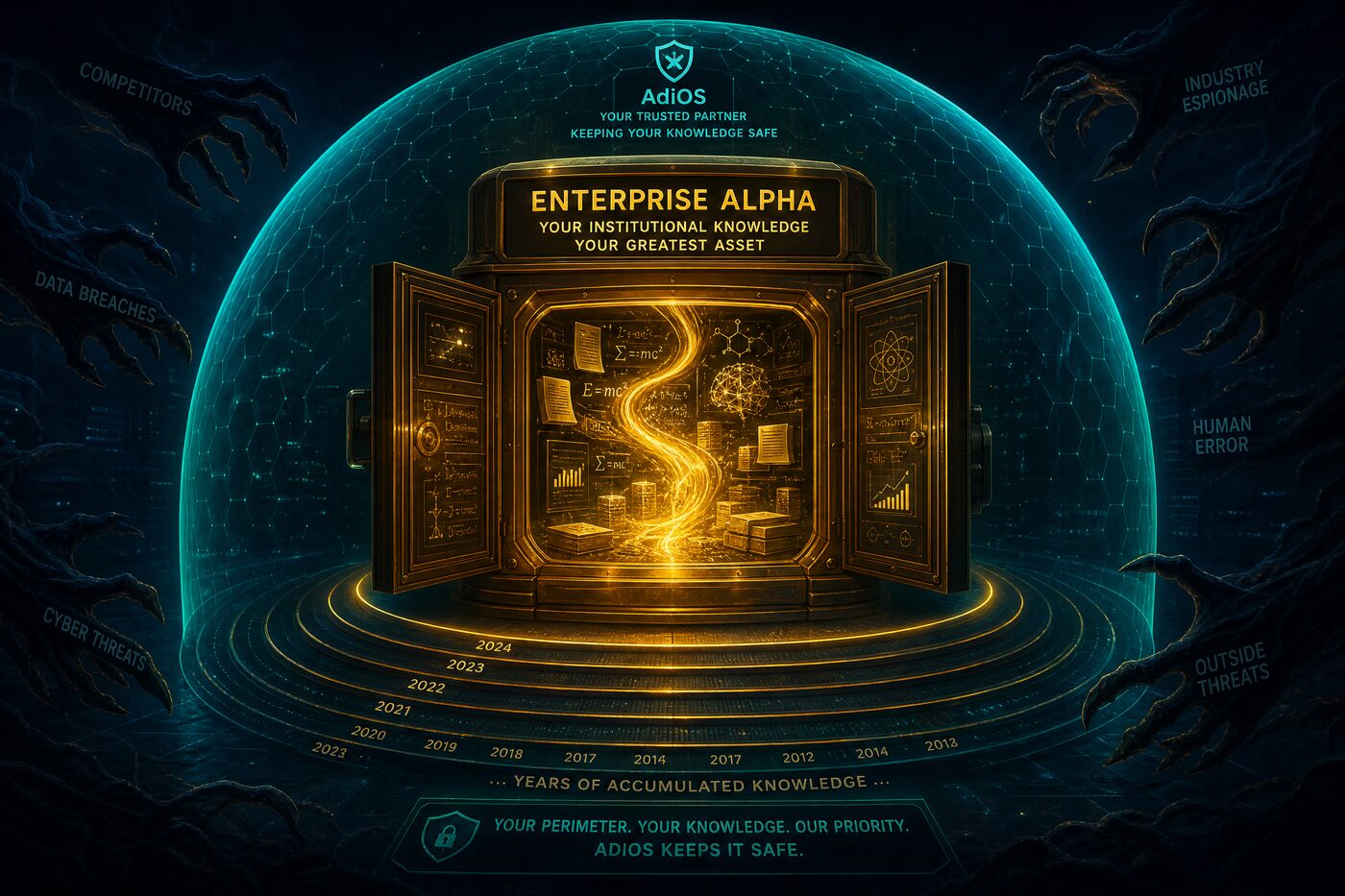
Enterprise Alpha is not stored in a database. It is distributed across every query your employees make, every document they process, every decision they take with AI assistance. When those queries travel to a cloud endpoint, they carry fragments of your Alpha with them. The model on the other end learns from them. Your advantage, distilled into weights, now partially lives on someone else's infrastructure.
Controlling your weights is controlling your fate. Weights are the distilled form of hard-won institutional knowledge. If you let others control your weights, you let them migrate the alpha of your business to theirs.
The implications are sector-specific. For a bank, Enterprise Alpha is its credit risk models, its fraud patterns, its customer behaviour. For a hospital, it is its clinical protocols and diagnostic accuracy built over thousands of cases. For a pharma company, it is its molecular research and formulation IP. None of this should ever leave the institution's perimeter.
The damage compounds
Alpha leakage is not linear. Each query enriches the vendor's model. A more capable vendor model attracts more clients. More clients generate more training data. The vendor's moat deepens while yours erodes. This is the structural trap of the cloud default, and it is the reason AdiOS was designed from first principles to keep intelligence inside the boundary that generates it.
An Operating System Where Sovereignty Is the Default
AdiOS is not a wrapper around a cloud AI. It is not a compliance layer bolted onto an LLM API. It is a ground-up sovereign intelligence operating system, where data sovereignty, regulatory alignment, and knowledge retention are properties of the architecture, not features you configure.
The platform rests on two interlocking halves. The Circular Operating System compounds knowledge. The Sovereign Mesh distributes it. Together they create an environment where inference runs inside the institution's perimeter, knowledge compounds with every interaction, and data stays where it belongs.
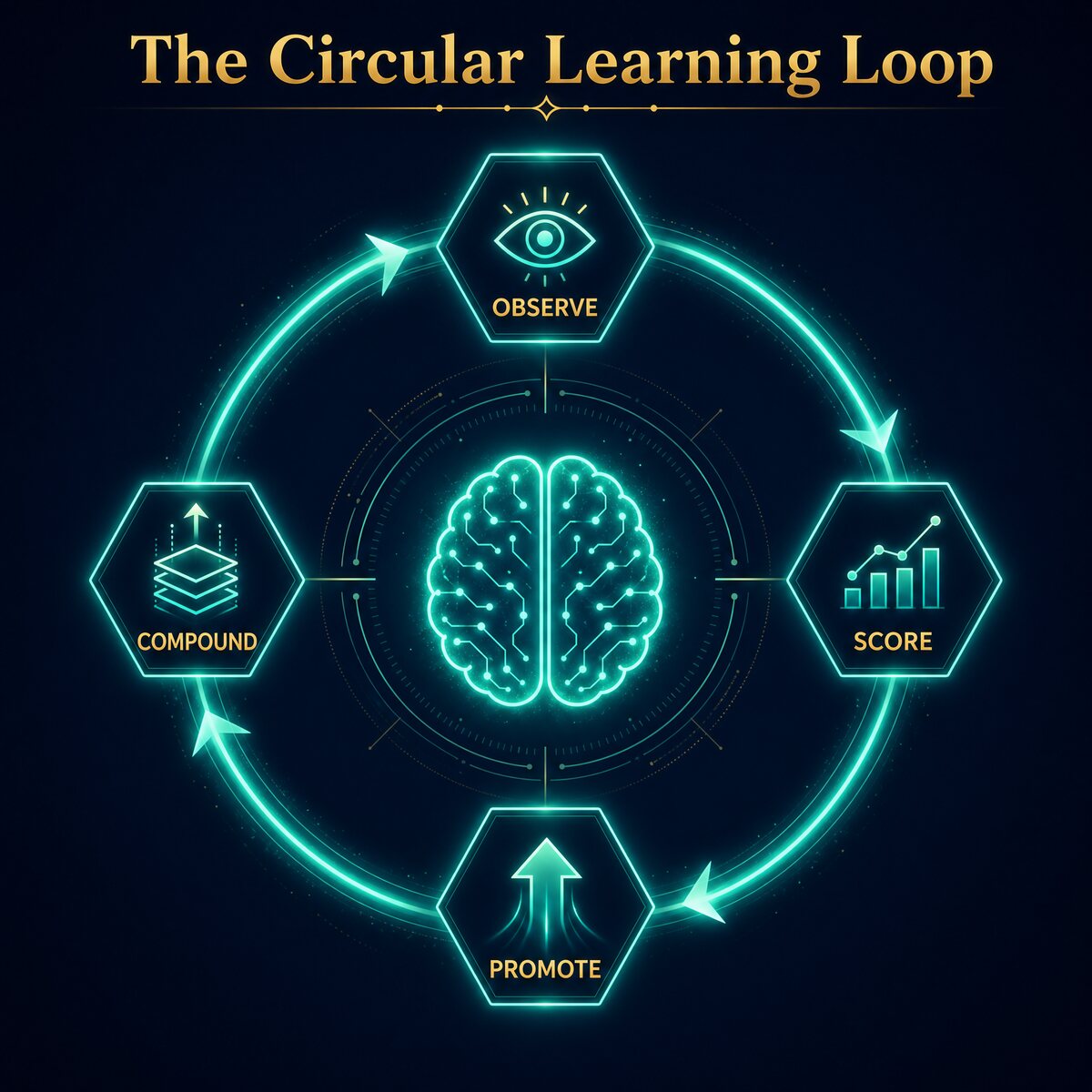
The Circular Learning Loop is what separates AdiOS from a conventional deployment. In a cloud setup, each query is stateless. The model returns an output, and the institution learns nothing structurally. The knowledge of that interaction dissipates. In AdiOS, every interaction is an input to the knowledge graph. The institution gets smarter with every use. The intelligence compounds. And it stays inside.
Here is the same choice, dimension by dimension.
| Dimension | Cloud AI default | The AdiOS way |
|---|---|---|
| Inference location | Foreign cloud server | Inside your perimeter |
| Data movement | Every query leaves the boundary | Stays inside by design |
| Knowledge ownership | Vendor enriched by your data | Your knowledge graph grows |
| Compliance | Bolt-on, manual audit | Enforced at the platform layer |
| Model lock-in | Vendor-specific APIs | Any model, swappable |
| Offline capability | Needs a connection | Offline-first by design |
| Cost model | Token billing, pay per query | Fixed infrastructure |
The Architecture Stack
AdiOS is a layered sovereign intelligence stack. Each layer serves a distinct function, and together they hold one contract: your data stays inside your perimeter.
A note on honesty, because it matters to us. The sovereignty gate and the universal policy ring are rolling out in phases across the platform through 2027, not switched on everywhere overnight. We state the architectural direction plainly, and we state its runtime status just as plainly. Sovereign by design is the commitment. The phased enforcement is the engineering reality, and we will not dress it up.
Why India Needs This More Than Anyone
India is not merely a large market for AI. It is a civilisational context that makes sovereign AI a necessity, not a preference. Regulatory urgency, linguistic diversity, infrastructure heterogeneity, and geopolitical sensitivity combine into a set of requirements no foreign cloud platform can fully meet.

The regulatory landscape
The Digital Personal Data Protection Act 2023 sets penalties up to ₹250 crore per violation. The RBI's FREE-AI framework asks financial AI for explainability and auditability that black-box cloud models cannot meet. SEBI's guidelines require complete audit trails for market AI. ABDM governs health data with strict localisation.
AdiOS maps to 13 regulators. Twenty-four rules are enforced in code today through adios-regionkit, with 397 more documented and on the roadmap to enforcement. The direction is compliance as architecture, not compliance as a checklist bolted on after the fact.
The infrastructure reality
India's AI infrastructure is maturing fast. AIRAWAT, the national AI supercomputer operated by C-DAC, delivers around 200 AI petaflops and has ranked among the world's top systems, per public reporting. The PARAM series provides distributed HPC across research institutions. Data centre capacity is growing quickly. The infrastructure for sovereign AI is being built. AdiOS is the operating system that runs on it.
Nine Principles of Sovereign Intelligence
These are not aspirational statements. They are the commitments the architecture is built to hold.
Why 2026 Is the Inflection Point
Several forces converged this year, and together they moved sovereign AI from a niche concern to a mainstream requirement.
The regulatory environment hardened. India's DPDP Act is in enforcement. The RBI's FREE-AI framework is being operationalised. SEBI issued AI guidelines with teeth. Across the EU, GDPR enforcement intensified and the EU AI Act is arriving. The cost of non-compliance is now real and quantifiable.
Enterprise disillusionment with cloud AI peaked. After two years of pilots, the reality is clear. A stateless, cloud-hosted model cannot accumulate institutional knowledge. Every query starts from zero. The organisation never gets smarter in a structural sense.
The infrastructure matured. Open-weight models have closed the capability gap for most enterprise use cases. On-premises GPU hardware is more accessible. India's national compute is operational. The technical barriers to sovereign AI have fallen.
AdiOS was designed before this wave of disillusionment. The problems it was built to solve, data sovereignty and knowledge compounding and regulatory alignment and linguistic diversity, are now the problems every AI leader is grappling with. The market has caught up to the architecture.
Stop paying a hidden wealth tax on your institutional knowledge. AdiOS lets your intelligence compound inside your perimeter, under your control.
Whether it is a credit model, a clinical protocol, or a decade of operational memory, the durable asset is yours.
Built with conviction. Sovereign by design.
AdiOS Platform Private Limited, Hyderabad. Regulatory figures reflect DPDP 2023, RBI FREE-AI, SEBI, and ABDM as of mid-2026. Compliance enforcement counts (24 enforced rules, 397 documented as of July 2026) are per adios-regionkit and have not been updated in this post; the enforced count reached 103 on 2026-08-25; platform-wide policy enforcement is rolling out in phases through 2027.