A story about what happens when two people decide the map is wrong.
Imagine a city.
A real city. Millions of people. Hospitals. Banks. Power grids. Courts. Schools.
Now imagine that every single building in that city was rented.
Not just the apartments. The hospitals. The banks. The city hall. The power station. Every structure that holds the city together, owned by a landlord who lives somewhere else. Someone you have never met. Someone whose interests are not yours.
The city functions. People go to work. Commerce happens. Life continues.
But nothing truly belongs to the city.
And one day, the landlord changes the terms.
That is not a hypothetical.
That is the story of enterprise technology in 2024.
The Quiet Crisis
Nobody announced it. There was no press conference.
It happened gradually, the way all the most important things happen. One vendor contract at a time. One cloud migration at a time. One "digital transformation" initiative at a time.
The intelligence layer of the modern enterprise quietly moved offshore.
The data went first. Then the processing. Then the reasoning. Then the decisions.
By the time most organisations realised what had happened, their most sensitive knowledge was living in infrastructure they did not own, governed by terms they had not fully read, in jurisdictions they had not chosen.
They had outsourced their minds.
McKinsey puts the sovereign AI market at $600 billion by 2030. That number exists because 62% of enterprises already cite data sovereignty as their single biggest blocker to deploying AI.
That is not a niche concern. That is the majority of the market, stuck at the door.
Two People. One Question. One Obsession.
Malay Baral and Rakesh Roy are co-founders based in Hyderabad.
They are not the kind of people who write long threads about disruption. They are the kind of people who open a code editor at six in the morning because a problem is bothering them.
The problem was this.
Every enterprise wants to be intelligent. But intelligence, in 2024, had become a utility supplied by someone else. Like electricity from a national grid. You plug in. You pay. You consume. You have no idea how it works or who controls the switch.
They thought about what it would mean to generate your own electricity.
Not for everyone. For the organisations that cannot afford to be dependent. The hospital that cannot have patient records leave the building. The bank that cannot have transaction logic processed overseas. The government body that cannot have citizen data sitting on a foreign server.
For them, renting intelligence is not a convenience. It is an existential risk.
Malay and Rakesh started building the power plant.
They Are Not Alone. That Is the Point.
Here is something worth saying directly.
They are not the first people to see this problem. They are not the only people building in this space.
Katonic AI is building sovereign AI stacks. VAST Data is rethinking enterprise data infrastructure. Accenture has a Sovereign AI practice. Amazon Web Services (AWS) launched its European Sovereign Cloud. The space is real and it is contested.
The difference is not that others do not exist. The difference is what AdiOS is trying to be.
Not a sovereign-flavoured cloud. Not a compliance wrapper around someone else's model. An actual operating system for enterprise intelligence. One that runs on your hardware and has no dependency on any external infrastructure whatsoever.
That distinction matters. And it is far harder to build.
The First Year
There is an image that cosmologists use to explain the early universe.
It is called the Cosmic Microwave Background. You cannot see it with your eyes. It requires sensitive radio telescopes to detect. It looks, when rendered as a visual map, like an almost perfectly uniform glow with the faintest temperature variations scattered across it.
Those variations are tiny. Almost imperceptible.
But those tiny variations are the seeds of everything. Every galaxy. Every star. Every planet. Every city. Every hospital that needs to keep its data inside its own walls.
The whole structured universe emerged from almost-uniform noise that only the right instrument could read.
The first year of AdiOS looked like that.
Not to an outside observer. To an outside observer it looked like two engineers making architectural decisions nobody would ever see. Components that worked in isolation and refused to cooperate when connected. Ideas that had to be rebuilt three times before they held their shape.
But the seeds were real.
What a Nervous System Looks Like While It Is Growing
Here is something remarkable about the human brain.
A newborn has almost all the neurons they will ever have. Roughly 100 billion. The same number as an adult.
What changes as a child grows is not the number of neurons. It is the connections between them.
A newborn brain has sparse connections. Simple reflexes. Basic responses.
By adulthood the same brain has formed trillions of synaptic connections. Dense. Overlapping. Self-reinforcing. Each new connection making every other connection more meaningful.
The brain does not grow by addition. It grows by integration.
The AdiOS codebase has been growing the same way.
The components were always in their heads. The connections between them are what have been forming, month by month, through 2025 and into 2026.
The Territory Nobody Mapped
Medieval cartographers had a problem. Their maps ended where their knowledge ended.
At the edge of the known world they wrote notes. The most common was Hic Sunt Leones. Here are lions. Unknown territory. Proceed with caution.
The phrase Hic Sunt Dracones appears on almost no historical maps at all. Two, by most accounts. But the idea it represents is real and ancient.
At the boundary of what is known, there is danger. Not because the territory itself is dangerous. Because nobody has mapped it yet.
For regulated enterprises needing sovereign AI, that boundary has been real for years.
The hospital in a country with strict data residency laws. The defence contractor whose supply chain cannot touch foreign infrastructure. The bank whose compliance team cannot answer the auditor's question about where the inference request actually travelled.
For them the map said: proceed with caution. Nobody has been here before.
Malay and Rakesh started mapping.
Not with a manifesto. Not with a pitch deck.
With code. One component at a time. One connection at a time.
April 2026: What the Map Looks Like Now
This is not a product diagram. This is not a marketing visual.
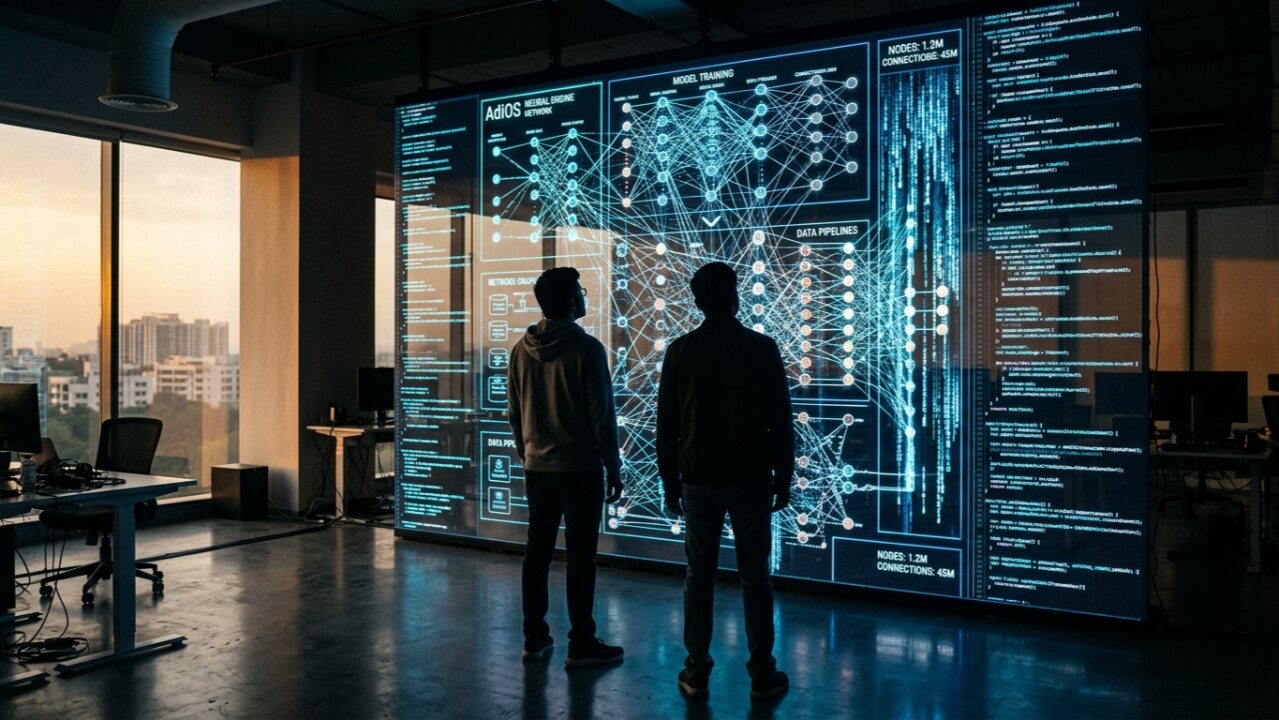
This is the build status of AdiOS. A live snapshot of the codebase dependency graph captured on the morning of April 15, 2026.
Every dot is a real module. Every line is a real dependency. Every dense cluster is months of engineering decisions that held together under pressure.
Look at the centre. That dense, almost dark mass of interconnected nodes. That is what happens when a system reaches the point where every part knows about every other part. When the connections outnumber the components. When the whole has become genuinely greater than the sum of its parts.
Compare it to the sparse outer edges. Those are the newest additions. Still finding their place. Still forming their connections.
The isolated clusters at the bottom? Separate subsystems, not yet pulled into the core. The next wave.
The platform is not finished. It is alive.
The Part That Is Hard to Explain in a Pitch Deck
Every startup has a founding story they polish for investors.
The insight. The market gap. The timing.
What is harder to explain is the part that happens after the insight. The months where you are building something that does not yet look impressive in a demo. Where the graph looks like scattered dots. Where the connections have not formed yet.
Malay and Rakesh have been living in that space.
Not complaining about it. Not performing the struggle for social media.
Just building.
The graph does not lie. Complexity like that does not emerge from a hackathon. It does not emerge from a well-funded team following a roadmap someone else wrote.
It emerges from people who cannot stop thinking about the problem. Who refactor at midnight because the architecture is not right yet. Who throw away months of work because a better solution revealed itself.
That graph is a portrait of conviction that survived contact with reality.
What Comes Next Is Not a Prediction. It Is Already Written.
The isolated clusters at the bottom of that graph will connect to the core.
The sparse outer nodes will find their density.
The blank spaces on the map will get filled in.
And somewhere, in a regulated industry, in a jurisdiction that cannot afford to rent its intelligence from a landlord it has never met, an organisation will run AdiOS on its own hardware for the first time.
No data will leave the building.
No vendor will own the switch.
The intelligence will belong to the people it serves.
That moment is not far away.
The city is being built.
A Final Note on Territory
The old maps were not wrong to mark their edges with warnings.
Unknown territory is genuinely hard. Building without a precedent costs more than following someone else's road.
But the organisations that need truly sovereign AI cannot follow someone else's road. The cloud providers want them on their cloud. The systems integrators want to sell them services. Nobody is building the thing they actually need.
Someone has to go first. Someone has to build the thing that does not exist yet.
Snapshot taken April 15, 2026. Hyderabad, India. Every node in that graph is real. Every connection was earned.
Originally published on LinkedIn on April 15, 2026.