AI intelligence is memory, not a service.
Most enterprise AI platforms treat memory as storage. Rows in a database. Vectors in an index. Files in a bucket. The brain does not work that way. And neither does AdiOS.
The Circular Operating System is not a database with a marketing metaphor painted on top. It is a cognitive architecture. The brain is the reference implementation. AdiOS is the sovereign, machine-executable version of it.
This post walks through the mapping. Component by component. Mechanism by mechanism.
1. The Working Hypothesis
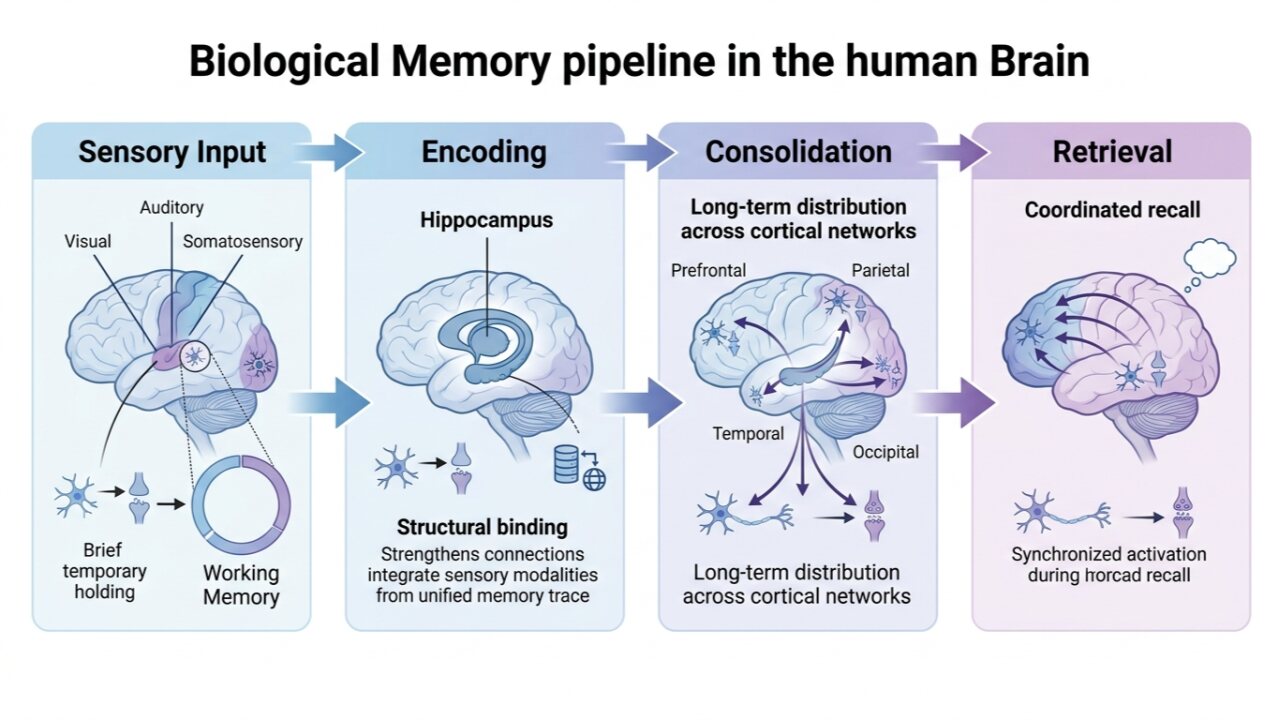
The neuroscience is settled on the broad shape. Memory is not one thing. It is a pipeline of states. Each state has a different substrate. Each state has a different job.
Figure 1: The biological memory pipeline. Temporary holding, structural binding, long-term distribution, coordinated by offline consolidation.
Now replace the labels with AdiOS components. The picture does not change.
Figure 2: The AdiOS memory pipeline. Same pipeline. Same shape. Sovereign by construction
2. The Direct Mapping
Fourteen brain mechanisms map one to one against AdiOS components. Not by analogy. By design.
Table 1: One to one.
Honest caveat on the glymphatic row. Sleep appears to support metabolic waste clearance in the brain, but the magnitude of the difference between sleep and wakefulness is still actively debated in the 2024-2025 literature [10]. I include this row because the functional analogy to security and bias filtering holds, not because the biology is settled.
3. The Circular Loop Is a Consolidation Cycle
Sleep research identifies three jobs the sleeping brain performs. Strengthen important memories. Prune weak connections. Restore the capacity to learn again.
The Circular Loop performs the same three jobs. This is not coincidence. It is the design.
Figure 3: The Circular Loop. Each revolution performs the same three jobs the sleeping brain performs every night
Cloud AI does none of this. It ingests. It infers. It forgets. The operator pays per token and receives an answer. Nothing compounds. Nothing consolidates. Nothing returns.
AdiOS inverts the direction. Every observation enters a loop that strengthens the whole. The node becomes smarter each cycle. The organisation becomes smarter each sync.
4. The Three Invariants Are Brain Invariants
The platform has three invariants that cannot be configured away. Each one has a neuroscience counterpart.
Figure 4: Three invariants. Three brain mechanisms. Same constraint in both direction
Invariant 1. Ephemeral Tier 1, Sovereign Tier 3
Working memory is session-scoped. Long-term memory never crosses the sovereign boundary. This is the prefrontal-to-hippocampal-to-cortical separation. The brain does not run long-term storage in the prefrontal cortex. AdiOS does not run long-term storage in the session layer.
Invariant 2. Sentinel Is the Universal Policy Ring
Every operation passes through adios-sentinel before execution. The brain does the same thing with attention. Input that does not pass the attention filter never reaches working memory. 24 enforced compliance rules + 397 documented frameworks. No bypass.
Invariant 3. Meridian CRDT Is Offline-First
Offline is the baseline. Sync is opportunistic. This is sleep. The node goes dark. Consolidation runs. On reconnect, accumulated traces replay into the mesh. A node that never goes offline never consolidates properly. The biology is clear on this. Sleep deprivation damages next-day learning [13].
5. Six Research Findings That Are Product Decisions
The neuroscience is not decorative. It is directly actionable. Six findings from the literature map to six concrete AdiOS design choices.
Table 2: Research findings, translated into product decisions
6. What This Changes for the Enterprise Buyer
The question a CTO at a regulated Indian enterprise should ask is simple. Does my AI remember?
Almost no cloud AI stack does. Each call is stateless. Context is reconstructed from scratch. The vendor compounds. The customer does not.
AdiOS flips this.
Figure 5: Two economic models. The brain metaphor is not neutral. It dictates who compounds
The DPDP Act 2023 comes into full force on May 13, 2027 [15]. Penalties reach INR 250 crore per violation under Section 33 of the Act. Every foreign API call for inference is a structural compliance risk. AdiOS closes that loop at the operating system layer, because the operating system layer is where memory should live.
7. Closing
The brain already solved the problem. It keeps memory sovereign to the organism. It consolidates during sleep. It prunes noise. It compounds signal. It survives disconnection. It does all of this on a twenty watt budget.
COS is the blueprint that formalises this pattern. AdiOS is the operating system that implements it. 42 components. 150,000 lines of Rust. 2,654 tests. 18 patent claims. One axiom.
Every operation is a circular transaction where value circulates within the community that generates it.
Neural memory systems have been refining this pattern across evolutionary time [16]. It works.
Sources
Neuroscience
[1] Tononi, G. and Cirelli, C. (2014). Sleep and the price of plasticity: From synaptic and cellular homeostasis to memory consolidation and integration. Neuron, 81(1), 12-34. See also the Synaptic Homeostasis Hypothesis (Tononi and Cirelli, 2006), Sleep Medicine Reviews, PMC3385863.
[2] Goldman-Rakic, P.S. (1995). Cellular basis of working memory. Neuron. See also PMC5447931, Role of the prefrontal cortex in working memory.
[3] Rolls, E.T. (2022). The hippocampus, ventromedial prefrontal cortex, and episodic and semantic memory. Progress in Neurobiology. See also Eichenbaum, H. (2017). On the integration of space, time, and memory. Neuron.
[4] Frankland, P.W. and Bontempi, B. (2005). The organization of recent and remote memories. Nature Reviews Neuroscience. See also Dudai, Y. (2004). Annual Review of Psychology. MIT News coverage of 2017 Tonegawa lab systems consolidation work.
[5] Tambini, A. and Davachi, L. (2019). Awake reactivation of prior experiences consolidates memories and biases cognition. Trends in Cognitive Sciences. Sleep is the strongest consolidation window, but recent work shows consolidation also happens during quiet wakefulness, a nuance reflected in Figure 1 above.
[6] Bliss, T.V.P. and Collingridge, G.L. (1993). A synaptic model of memory: long-term potentiation in the hippocampus. Nature. See also Queensland Brain Institute overview of long-term synaptic plasticity.
[7] Diekelmann, S. and Born, J. (2010). The memory function of sleep. Nature Reviews Neuroscience. See also Klinzing, J.G. et al. (2019). Mechanisms of systems memory consolidation during sleep. Nature Neuroscience.
[8] Li, W. et al. (2017). REM sleep selectively prunes and maintains new synapses in development and learning. Nature Neuroscience. See also Nature Communications 2020 on REM-dependent dendritic spine formation.
[9] Xie, L. et al. (2013). Sleep drives metabolite clearance from the adult brain. Science, 342(6156), 373-377.
[10] Miao, A. et al. (2024). Brain clearance is reduced during sleep and anesthesia. Nature Neuroscience. See also 2025 Science coverage of ongoing debate about glymphatic clearance rates.
[11] Blumenfeld, R.S. and Ranganath, C. (2007). Prefrontal cortex and long-term memory encoding. The Neuroscientist. See also PMC6675388, Dorsolateral prefrontal cortex promotes long-term memory formation through its role in working memory organization.
[12] Dudai, Y., Karni, A. and Born, J. (2015). The consolidation and transformation of memory. Neuron. See also PMC3039647 on differential consolidation.
[13] Walker, M.P. and Stickgold, R. (2006). Sleep, memory, and plasticity. Annual Review of Psychology. See also National Sleep Foundation resources on memory and sleep.
[14] Wamsley, E.J. and Stickgold, R. (2011). Dreaming and offline memory processing. Current Biology. See also PMC coverage of dreaming and offline memory consolidation.
Regulatory
[15] Digital Personal Data Protection Act, 2023. Ministry of Electronics and Information Technology, Government of India. Section 33 covers financial penalties. Enforcement date per MeitY notification schedule.
Evolution
[16] Allen, T.A. and Fortin, N.J. (2013). The evolution of episodic memory. PNAS, 110 (Supplement 2), 10379-10386.
Malay Baral, Founder and CTO of AdiOS Platform Private Limited.
Originally published on LinkedIn on April 19, 2026.
Platform figures in this post (components, lines of Rust, tests, enforced compliance rules) are as of April 2026 and have not been updated. For current figures see adiosplat.io. The patent figure was corrected on 2026-09-25: the earlier "9 patent claims" came from a draft that was never filed. The filed application is 202641042703, 20 claims as filed and 18 after amendment, under examination, not granted.