
By Malay Baral, AdiOS Platform | July 2026
AI systems are reshaping global power. Corporations build digital fortresses to protect their proprietary intelligence. Military systems use AI for operational targeting. A critical question remains unanswered. Who protects the integrity of the public?
The Dual Injustice of the AI Age
The AI age brings a dual injustice. Corporations fear intellectual property theft. Citizens fear mass surveillance and algorithmic control. This tension hits hardest in digital identity.
States and private entities are digitizing civic life at speed. Traditional centralized identity systems are becoming liabilities. They threaten privacy. They threaten autonomy. They concentrate power in the wrong hands.
The solution is a paradigm shift. Self-Sovereign Identity (SSI) places the citizen at the center of every identity transaction. It is not a future concept. It is a present imperative.
What Is Self-Sovereign Identity?
Self-Sovereign Identity operates independently. It does not rely on third-party actors. It uses decentralized architectures. It prioritizes user security, privacy, and individual autonomy.
The word sovereign is deliberate. Each person has an inherent right to control their own identity data. SSI does not eliminate governments or institutions. A government still issues a passport. A university still issues a degree. SSI decouples the issuance of credentials from their control and storage. The citizen holds the power.
Researchers describe SSI as identity management that puts individuals at the center of their identity transactions, free of any centralized authority (Internet Policy Review, 2021).
Christopher Allen articulated the foundational framework in 2016. The World Bank, the World Economic Forum, and the ID2020 Alliance refined and adopted it. Ten core principles define what a true SSI system must deliver.
Synthesized from Christopher Allen (2016) and New America.
The Technical Foundation: W3C DIDs and Verifiable Credentials
Two interconnected W3C standards realize SSI. Decentralized Identifiers (DIDs) and Verifiable Credentials (VCs).
A Decentralized Identifier is globally unique. It does not rely on a centralized registry. The citizen controls it. A third party cannot revoke it. A DID looks like this:
did:key:z6Mk8Gf6VqY9LqWmxvQWc9x7yK8kH74Fq3G16w42B6Q
Each DID resolves to a DID Document. The document contains public keys. It enables cryptographic verification of claims. No central authority required.
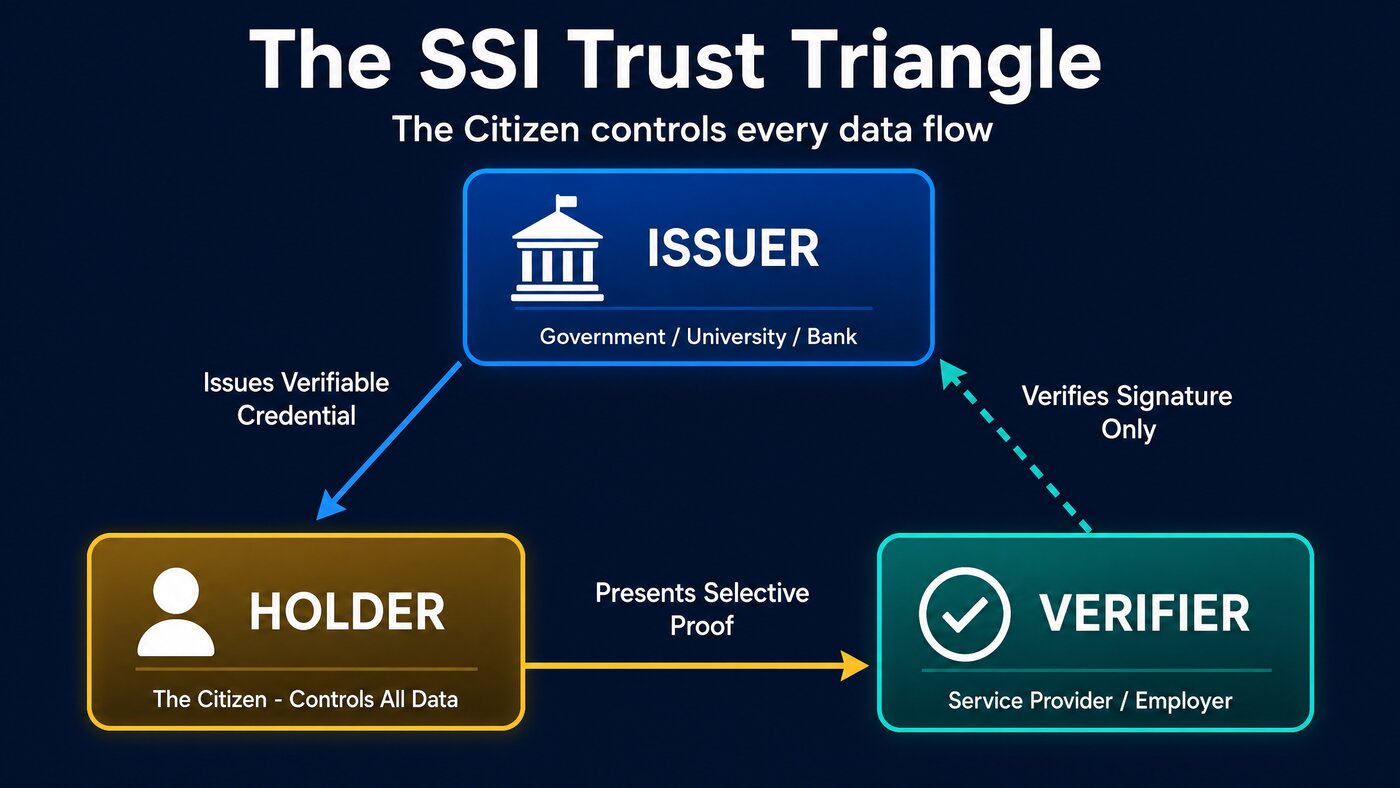
Bound to a citizen's DID are Verifiable Credentials. Digital equivalents of physical documents. Passports. Driving licenses. University degrees. An issuer signs a VC cryptographically. The citizen stores it in a digital wallet. The citizen presents it directly to a verifier. The issuer is never involved in the transaction.
The most powerful feature is selective disclosure. Prove you are over 18 without revealing your date of birth. Prove you hold a valid driving license without disclosing your home address. The power dynamic shifts. The citizen controls the flow. Not the verifier.
Case Study: India's Aadhaar
Aadhaar is the world's largest biometric digital identity system. Over 1.38 billion identity numbers generated. Roughly 96% of India's population covered. It achieved massive financial inclusion. It brought hundreds of millions into the formal economy. That is civilization-scale infrastructure, and it must not be broken.
But Aadhaar's architecture predates SSI. Biometric data lives in a centralized database. Central storage creates a single point of failure. In October 2023, researchers reported that identifying information of roughly 815 million Indians appeared on the dark web (Tech Policy Press, 2025). One vulnerability can expose a nation.
The scope keeps expanding. Private companies now access Aadhaar-linked facial recognition. A welfare tool drifts toward commercial surveillance infrastructure. This is the structural cost of the centralized model. Efficiency, purchased at the price of sovereignty.
Measured against SSI principles, the picture is mixed. Strong on inclusion. Improving on consent through Virtual ID. Structurally centralized on control, minimization, and protection. The fix is not to replace Aadhaar. The fix is a citizen-held trust layer on top of it. We made that argument in detail in our India DPI essay: keep the rails, add portable, user-held, cryptographically verifiable proof.
Case Study: The Netherlands and eIDAS 2.0
The Netherlands takes a different path. The Burgerservicenummer (BSN) is a unique personal number for all government interactions. It is not biometric. It underpins a federated ecosystem accessed through DigiD.
DigiD does not store data in one central biometric database. That is more privacy-conscious. But it still relies on centralized government validation. The Dutch government has mandated that only European companies manage DigiD's infrastructure by 2028. National security drove that decision.
The transformative development is eIDAS 2.0. It mandates that all 27 EU Member States provide an EU Digital Identity (EUDI) Wallet to citizens by December 2026. The Netherlands is building its national implementation, the NL Wallet.
The EUDI Wallet is a major step toward SSI. Citizens store personal data locally, on their own devices. Not on a government server. Selective disclosure is the defining feature. Share only the minimum necessary. Monitor what you shared, with whom, and why. The wallet integrates W3C Verifiable Credentials natively. It bridges government authority with decentralized standards.
Three Systems, One Direction
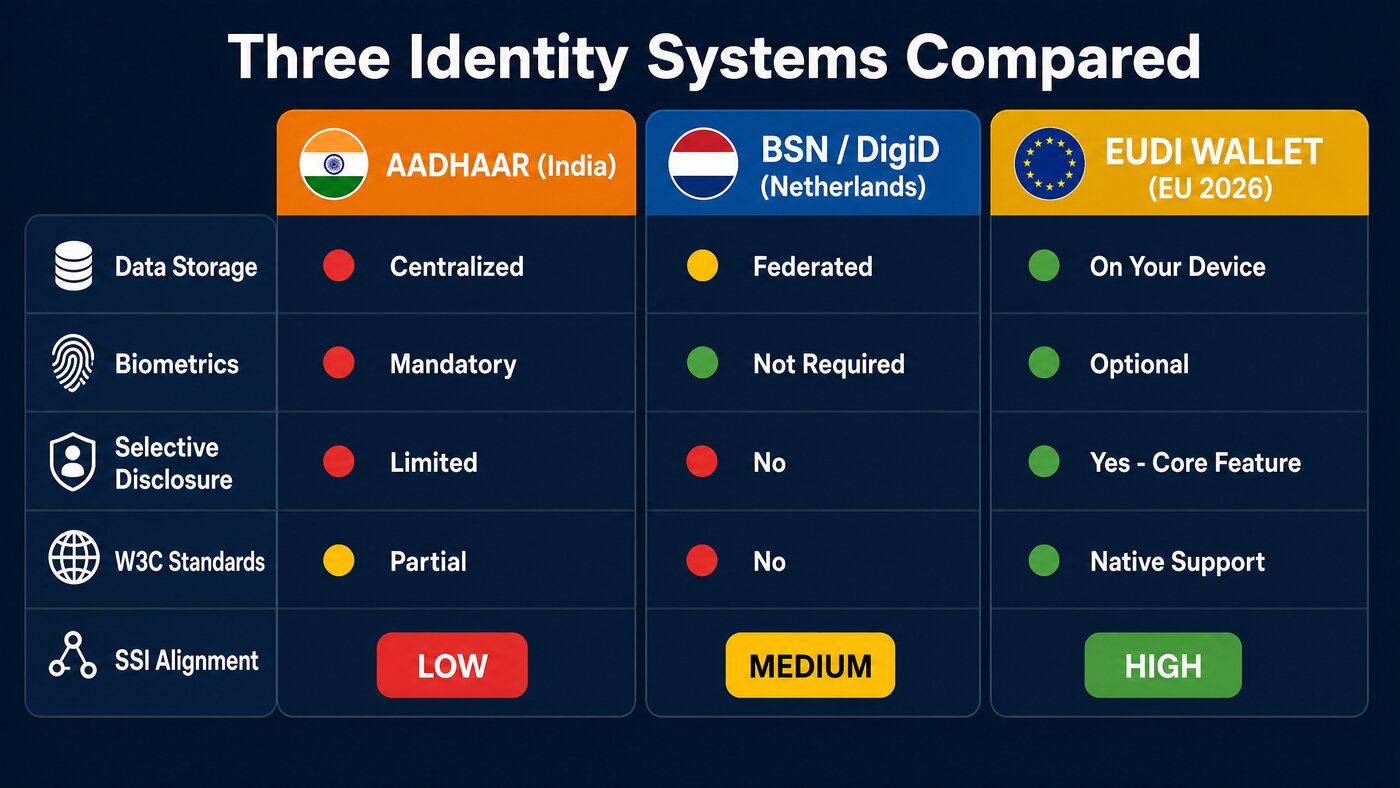
| Dimension | Aadhaar (India) | BSN / DigiD (NL) | EUDI Wallet (EU 2026) |
|---|---|---|---|
| Data storage | Centralized | Federated | On your device |
| Biometrics | Mandatory | Not required | Optional |
| Selective disclosure | Limited | No | Yes, core feature |
| W3C standards | Partial | No | Native support |
| SSI alignment | LOW | MEDIUM | HIGH |
Aadhaar delivers inclusion at unmatched scale. DigiD delivers privacy-conscious federation. The EUDI Wallet delivers the full SSI promise. The direction of travel is clear. Identity is moving to the citizen's device, under the citizen's control.
The Broader Stakes: AI, Surveillance, and the Public Interest
The urgency is real. AI lets corporations extract value from proprietary data at scale. Military systems build operational targeting databases. The same capabilities can be turned toward citizens. AI-powered surveillance aggregates identity data at scale.
A centralized identity database is not merely a privacy risk. It is surveillance infrastructure waiting to be weaponized. Who controls identity data is inseparable from who controls AI. If the state or the corporation controls both, the public's integrity is perpetually at risk.
When military and corporate powers merge to protect their own dominance, someone must still protect the public. That is the dual injustice in one sentence.
SSI is the structural answer. Identity data resides with the citizen. Disclosed only with explicit consent. Verifiable without centralized intermediaries. SSI makes mass surveillance architecturally difficult. It is the technological foundation for a rights-respecting digital society.
The EU shows governments can choose to empower citizens rather than surveil them. India shows what world-class inclusion rails look like, and what they still need. The path forward runs through both.
Where AdiOS Stands
We did not write this essay as bystanders. Identity-by-design is a founding commitment of the AdiOS platform.
Every participant in an AdiOS mesh carries a W3C DID. Every node. Every component. Every AI agent. Every human. No anonymous participants. Credentials flow as W3C Verifiable Credentials, verified by signature, not by calling a central server. Sovereign data stays on the node that owns it.
We build this way for the same reason citizens need SSI. Intelligence that compounds inside an institution must answer to the institution. Identity that belongs to a person must answer to the person. Same principle. Same architecture. Same standards.
Self-Sovereign Identity places the citizen at the center. Armed with cryptographically verifiable credentials. Protected by data minimization. Empowered by the right to consent.
This is not a future concept. It is a present imperative. W3C DIDs and Verifiable Credentials exist today. The EUDI Wallet launches in 2026. The tools are ready.
The only question is whether we choose to use them.
References
- Allen, C. "The Path to Self-Sovereign Identity." Life With Alacrity, 2016.
- Giannopoulou, A. "Self-sovereign identity." Internet Policy Review, 2021.
- New America. "The Principles of Self-Sovereign Identity."
- Larkin, C.J. and DiResta, R. "Lessons from National Digital ID Systems." Tech Policy Press, June 2025.
- Digital Government Netherlands. "The EUDI Wallet." 2026.
- EUDI Wallet Architecture and Reference Framework.
- Didit.me. "W3C Decentralized Identifiers (DID) Explained." 2026.
- "AI Integrity: Dual Injustice." Video essay, 2026.
AdiOS Platform Private Limited | Hyderabad, India
Every participant gets a DID. No blockchain required. Sovereign by design.