
By Malay Baral, AdiOS Platform | July 2026
The AI industry has spent three years arguing about weights. Open weights or closed weights. This lab's frontier model or that one's. Which API, which license, which leaderboard.
Watch the leaderboards for one quarter and the argument answers itself. Every lead evaporates. Open releases erase closed advantages in months. Recent analysis shows open-weight models lag frontier closed models by an average of only four months.1 Whatever model you standardise on today will be obsolete before your procurement cycle closes.
Here is the test. If swapping the model resets your AI capability, the model was your asset, and you never had one. Models come and go. An asset that comes and goes is not an asset. It is a subscription.
What "proprietary" used to mean
The word has already changed meaning twice.
In the software era, proprietary meant the closed codebase. Open source and SaaS commoditised it.
In the model era, the era we are leaving, proprietary means closed weights. That is the definition being commoditised right now, in public, every quarter.
The third definition is the durable one. Proprietary means the intelligence your institution generates. The judgment of your people. The shape of your processes. The patterns in your decisions. The knowledge that compounds from every question your organisation answers.
Nobody can commoditise that. Nobody else has it.
The alpha you are leaking

Palantir CEO Alex Karp has a name for it: enterprise alpha. Your proprietary operational logic. Your sensitive data. Your entire competitive advantage.
His charge against centralised AI is blunt. Enterprises pay millions for tokens, and in return they hand their alpha to the model's developer. He calls it a hidden wealth tax.2 You fund the very tools that absorb your trade secrets.
Take an insurance carrier. Its fraud signatures come from decades of paid claims. Feed them to a vendor's cloud model and the vendor's product gets sharper. The next carrier to buy that product benefits from your loss history. You paid to sharpen your competition.
Karp named the problem correctly. The answer, though, is not renting a different fortress. The answer is owning the operating layer.
Models are utilities

Nobody asks whether their electricity is proprietary. They ask what they build with it.
Models are reaching the same status. Metered. Swappable. Improving. Interchangeable. Open-weight, frontier, tiny, domain specialist: all of them are utilities. The cost of LLM inference has dropped by a factor of 1,000 in three years.3 And the models themselves will account for only about one percent of the $2.52 trillion worldwide AI spending forecast for 2026.4
At AdiOS we hold this as a locked design rule. Any model, internal or external, is secondary. It is always tasked to improve the institution's brain. We admit any utility through the sovereign perimeter if it passes one yardstick: does it improve the enterprise alpha and strengthen the perimeter. No utility is ever the asset.
This inverts the usual deployment. The model's job is not to answer. The answer is a byproduct. The model's job is to leave behind a durable learning that the institution keeps. Do that on every interaction and something changes: you can swap the model any time, and the intelligence survives the swap. That is the practical difference between owning your alpha and renting your intelligence.
The accountability clause
There is a harder edge to this, and regulated institutions feel it first. MIT research shows that 95 percent of enterprise generative AI pilots fail to deliver ROI.5 Most stall because they cannot safely integrate into real, accountable business processes.
A regulator will not accept "the vendor's model decided." When a bank denies a loan, when a carrier rejects a claim, when a hospital flags a patient, the institution owns that decision. Accountability cannot be rented out with the inference bill.
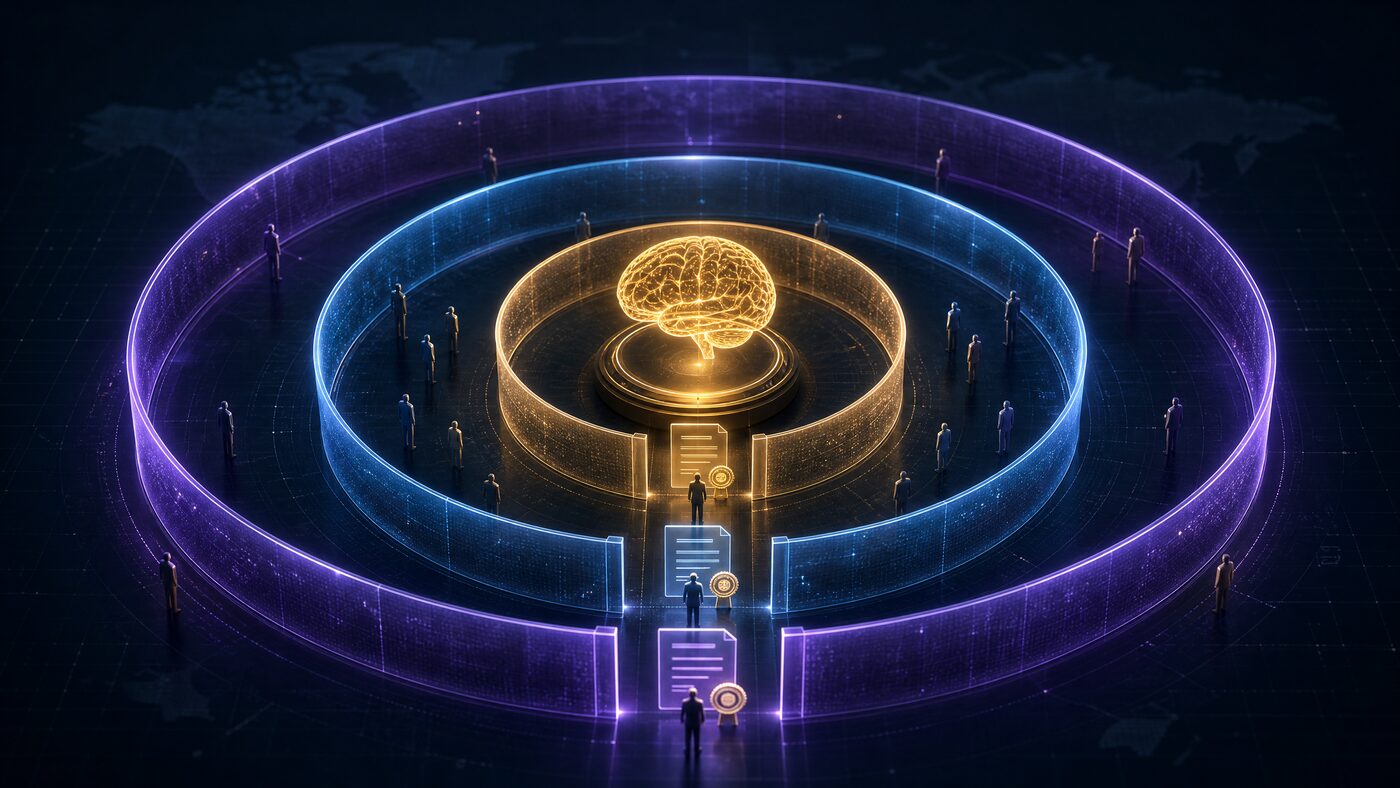
Owning accountability means owning the chain. What was observed. What confidence it earned. Who promoted it. Which policy allowed it. Who signed it. That chain can only exist if the intelligence lives inside your boundary.
And the boundary is layered. The enterprise perimeter. The nation's data residency and sectoral rules. The state or bloc regime above that. Intelligence, people, and process must be accountable within all three. This is not a compliance checkbox. It is the ownership structure of the AI era.
What this demands from architecture
If proprietary means your intelligence, your architecture must treat it that way.
Working memory should be ephemeral. Long-term institutional memory should be sovereign and never cross the boundary. Every learning should carry a confidence score and earn promotion: personal observation, then domain knowledge, then enterprise grade. Every decision should carry a signed, auditable identity. Compliance should be enforced at the OS layer, not bolted onto the application. And every model should sit behind one router, replaceable without touching the brain.
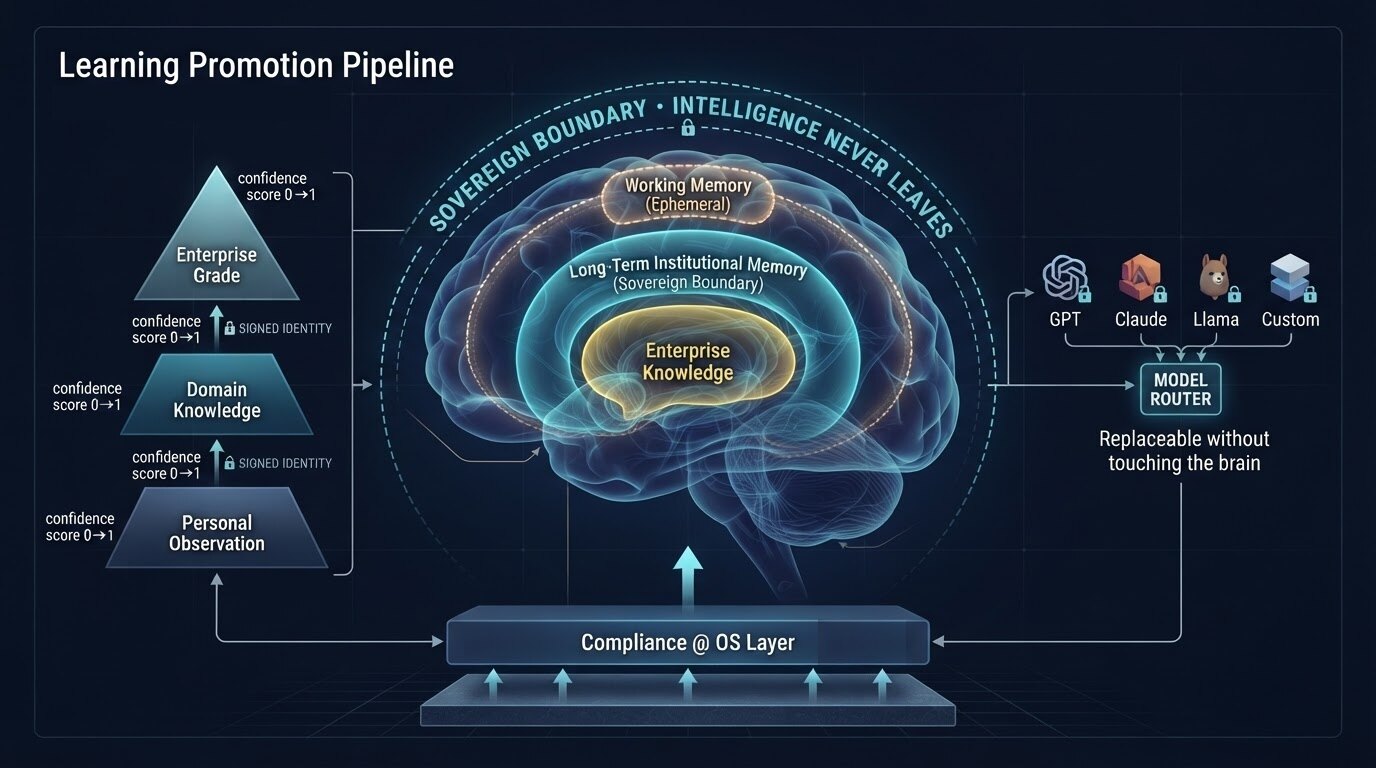
This is what we build. AdiOS is the sovereign AI operating system architected after the human brain. Intelligence compounds inside the institution that generates it. It never resets. It never leaves the boundary.
The one line to keep
The open versus closed debate will keep generating headlines. Let it. It is a pricing war between utilities.
The question that decides the next decade of enterprise AI is simpler. When your model changes, does your intelligence survive?
Whatever model you run this year, the durable asset is the intelligence your institution generates: the judgment, the processes, the patterns nobody else has.
Build like it.
References
- Epoch AI. Open models lag state-of-the-art closed models by 4 months.
- Yahoo Finance. Palantir CEO Alex Karp: Enterprises Are "Livid" Over AI Models That "Steal" Their Business Value.
- a16z. Welcome to LLMflation: LLM inference cost is going down fast.
- Gartner. Worldwide AI Spending Will Total $2.5 Trillion in 2026.
- Fortune. MIT report: 95% of generative AI pilots at companies are failing.
- EU AI Act. Article 99: Penalties.
AdiOS Platform Private Limited, Hyderabad. The model is a utility. The intelligence is proprietary.