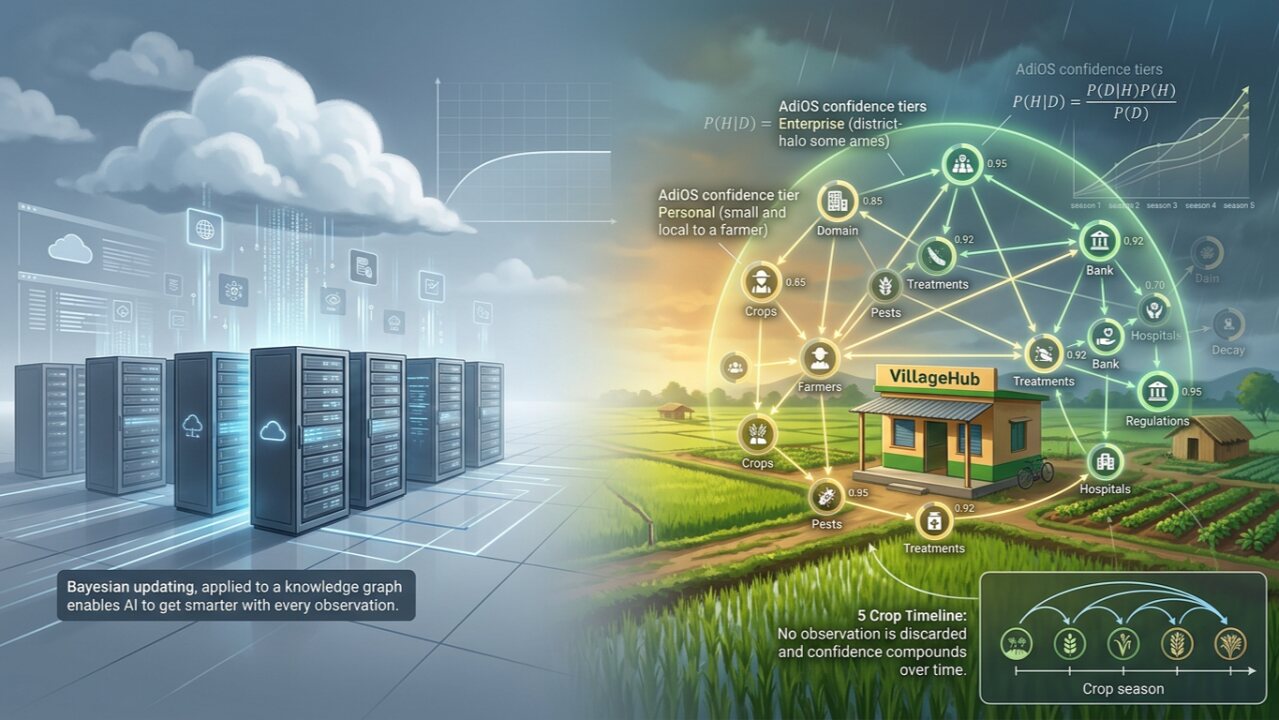
How Bayesian updating applied to a knowledge graph produces AI that gets smarter with every observation
"It is a capital mistake to theorize before one has data. Insensibly one begins to twist facts to suit theories, instead of theories to suit facts."
Prologue: What Cloud AI Cannot Remember
Every time you call a cloud AI, you start from zero.
The model has weights trained on historical data. It does not carry forward what happened last Tuesday in a specific paddy field in Andhra Pradesh. It does not remember that the same pest appeared in the same cluster three seasons ago, that the intervention succeeded, and that the confidence on that treatment is now grounded in observed outcomes.
It generates. It does not learn from your specific context between calls. It cannot. The graph does not persist.
This is not a criticism. It is a design constraint. Stateless inference is fast, cheap, and horizontally scalable. For many tasks, it is exactly what is needed.
But for the class of problems that define India's regulated sectors, it is insufficient. A bank assessing a borrower over twelve years of behavior needs a graph that compounds. A hospital tracking a patient across a chronic disease trajectory needs a knowledge structure that remembers. A farmer managing a microclimate across seasons needs intelligence that accumulates rather than resets.
AdiOS was built on a principle that dates to 1763.
Act I: The Reverends Discovery
Thomas Bayes was an eighteenth-century English minister with an unusual hobby. He was working on a problem that had no name yet.
The question he posed was this: given some observed evidence, how should a rational agent update its degree of belief in a hypothesis?
He did not publish his answer during his lifetime. His friend Richard Price submitted the manuscript to the Royal Society two years after Bayes died. The paper appeared in Philosophical Transactions in 1763.
The theorem it contained is now one of the most consequential equations in the history of science.
Figure 1: Bayes' Theorem - the formula for rational belief update
Each observation moves you toward the truth. No observation is discarded. The system's estimate improves monotonically as evidence accumulates.
This is the mathematical foundation of the AdiOS confidence tier system.
Act II: The Knowledge Graph as a Bayesian Network
A knowledge graph is a directed labeled graph. Each node is an entity. Each edge is a relationship with a direction and a label.
Figure 2: confidence promotion: each new evidence vector updates the score
The key insight is that confidence is not a label. It is a score derived from a Bayesian updating process applied to the assertion itself.
The prior is the initial observation. The likelihood updates are structured evidence events. The posterior is the new confidence score.
This process runs continuously, automatically, and locally on every AdiOS node.
Act III: The Three Confidence Tiers
AdiOS adios-meridian defines three canonical confidence thresholds. These are not arbitrary labels. Each represents a meaningful epistemic state.
Every write to the AdiOS adios-seedvault enters at 0.70. An uncorroborated single observation is always personal-tier.
Promotion from Personal to Domain requires corroborating evidence. The adios-cortex orbit scoring engine evaluates:
- Cross-references with existing triples in the graph
- Named entity extraction and concept alignment
- Domain-specific validation rules from the active sector pack
- Temporal coherence with event timestamps
- Agreement from multiple independent observers
Promotion from Domain to Enterprise requires outcome evidence. The loop closes. The intervention was applied. The result was recorded. The knowledge is now grounded in a specific real-world outcome.
This is Bayesian updating implemented as a knowledge graph pipeline.
Act IV: The Compounding Effect Over Time
The power of this architecture becomes visible across time.
Season one: the VillageHub at a gram panchayat in Vidarbha has one season of pest observations. Confidence on crop-pest-treatment triples averages 0.75. Recommendations are cautious.
Season two: two seasons of outcomes. Confidence on validated triples reaches 0.85. The system begins to distinguish between interventions that worked in this specific microclimate versus those that worked in general.
Season three: confidence on high-frequency triples reaches 0.92. The knowledge graph now contains microclimate-specific intelligence grounded in three years of observed outcomes from this cluster. No general-purpose model trained on global data contains this knowledge. No cloud AI can reproduce it without the locally accumulated graph.
The cloud model's performance is flat. It knows what it was trained on. The AdiOS graph's performance increases. It knows what happened here, in this field, with this farmer, last monsoon.
This asymmetry widens over time. By season five, the local graph contains five years of microclimate-specific grounded knowledge. No training run on a foreign cloud server will ever contain that graph. It lives on the node. The sovereignty is structural, not contractual.
Act V: Decay and the Anti-Staleness Mechanism
Bayesian updating is not only about increasing confidence. Evidence can also decrease it.
AdiOS adios-compound implements a confidence decay function. Assertions that are not reinforced by new evidence lose confidence over time. This prevents stale knowledge from persisting at high confidence scores.
The decay function is configurable per domain pack. A pest observation from four seasons ago that has not been seen since decays toward 0.70 over twelve months. A regulatory rule from a superseded framework decays immediately when the new framework is loaded.
This is the Bayesian mechanism running in reverse. Absence of confirming evidence is itself a signal. Knowledge that is never reinforced should be held with lower confidence than knowledge that is regularly validated.
The system models the world accurately because it models uncertainty accurately.
Act VI: The Agricultural Case at Scale
Consider how this architecture plays out across a district.
The district contains 847 active VillageHub nodes. Each node accumulates local observations. adios-meridian CRDT sync propagates high-confidence triples across the mesh. A pest-treatment outcome that reaches 0.95 at one VillageHub promotes to Enterprise tier and syncs to the district-level graph.
The district-level graph now holds Enterprise-tier knowledge grounded in outcomes from 847 local contexts. The district agronomist consults a graph that has absorbed twelve months of distributed real-world validation.
Figure 5: Distributed Bayesian accumulation across a district mesh
No foreign API was called. No data left the sovereignty boundary. The intelligence is a product of the district itself.
Epilogue: The Season Three Farmer
Season three. Ramswaroop's paddy crop shows early signs of stem borer damage.
He opens the AdiOS field interface on his VillageHub kiosk. The knowledge graph already holds two seasons of stem borer observations from his cluster. It holds the confidence scores on three treatment approaches. One approach has a 0.94 confidence score based on observed yields across eleven farms in similar microclimates over two seasons.
The recommendation is specific. It is grounded. It is not a generic answer from a model trained on data from Wisconsin.
This is what compounding intelligence means in practice.
References
- Bayes, T. (posthumous, 1763). An Essay towards Solving a Problem in the Doctrine of Chances. Philosophical Transactions of the Royal Society of London, 53, 370-418. Submitted by R. Price.
- Jaynes, E.T. (2003). Probability Theory: The Logic of Science. Cambridge University Press.
- Koller, D. and Friedman, N. (2009). Probabilistic Graphical Models: Principles and Techniques. MIT Press.
- Pearl, J. (1988). Probabilistic Reasoning in Intelligent Systems: Networks of Plausible Inference. Morgan Kaufmann.
- Fensel, D., et al. (2020). Knowledge Graphs: Methodology, Tools and Selected Use Cases. Springer.
- Angles, R. and Gutierrez, C. (2008). Survey of Graph Database Models. ACM Computing Surveys, 40(1).
- Bizer, C., Heath, T., and Berners-Lee, T. (2009). Linked Data: The Story So Far. International Journal on Semantic Web and Information Systems, 5(3).
This post is part of the AdiOS technical series. AdiOS Platform Private Limited, adiosplat.io DPIIT Recognised Deep Tech Startup, Hyderabad, India.
Originally published on LinkedIn on April 29, 2026.