An AdiOS analysis of primary sources. Audit date: 22 September 2026.
A chart has been circulating this month. It shows nine AI companies filling in every layer of a stack: applications, models, cloud, silicon. The headline says everyone is racing to vertically integrate.
I had every dated claim in it checked against a primary source. The strategic shift the chart points at is real. The self-sufficiency it implies is fiction.
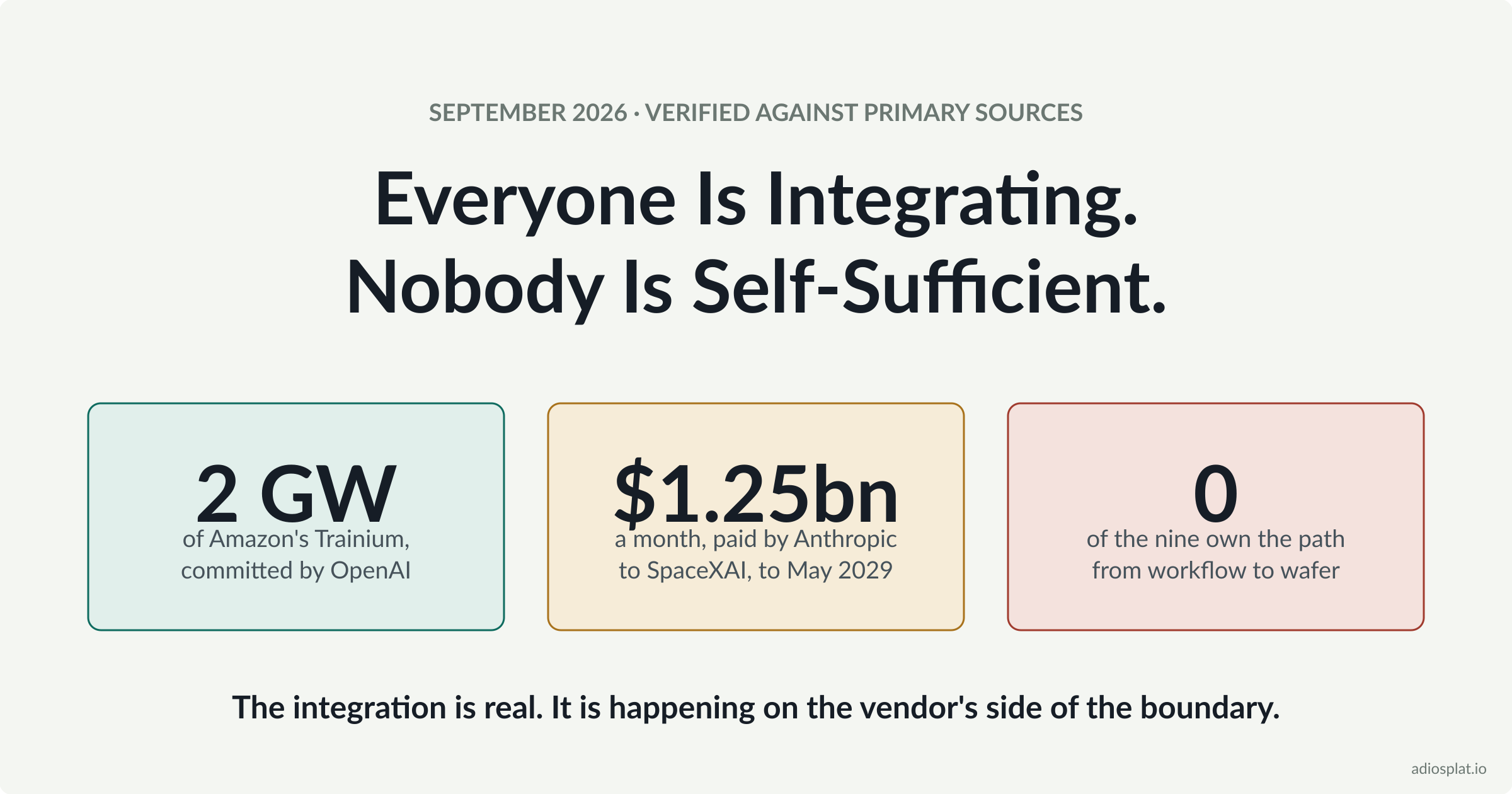
OpenAI will consume two gigawatts of Amazon's accelerator. Anthropic pays SpaceXAI 1.25 billion dollars a month for Colossus. Microsoft shipped seven of its own models in June to reduce its dependence on OpenAI, in the same quarter that OpenAI unveiled its own chip to reduce its dependence on NVIDIA.
Every one of these companies is integrating exactly the layers that decide its own cost, and renting the rest from a competitor. That is a coherent strategy. It is not the one the chart claims. And it leaves the most important question unasked.
What a grid of coloured boxes cannot say
The image adapts slide 13 of Battery Ventures' State of AI Report 2025, published in December.1 Battery's own headline is narrower than the viral version. Battery wrote that early leaders are racing to vertically integrate. The circulating version says everyone.
That single word carries the whole error. "Early leaders" is a bounded observation about a handful of firms. "Everyone" is a claim about an industry, and the source never made it.
The deeper problem is what a coloured box can encode. It says a company appears at a layer. It cannot say how it appears there. In this stack, how matters far more than whether.
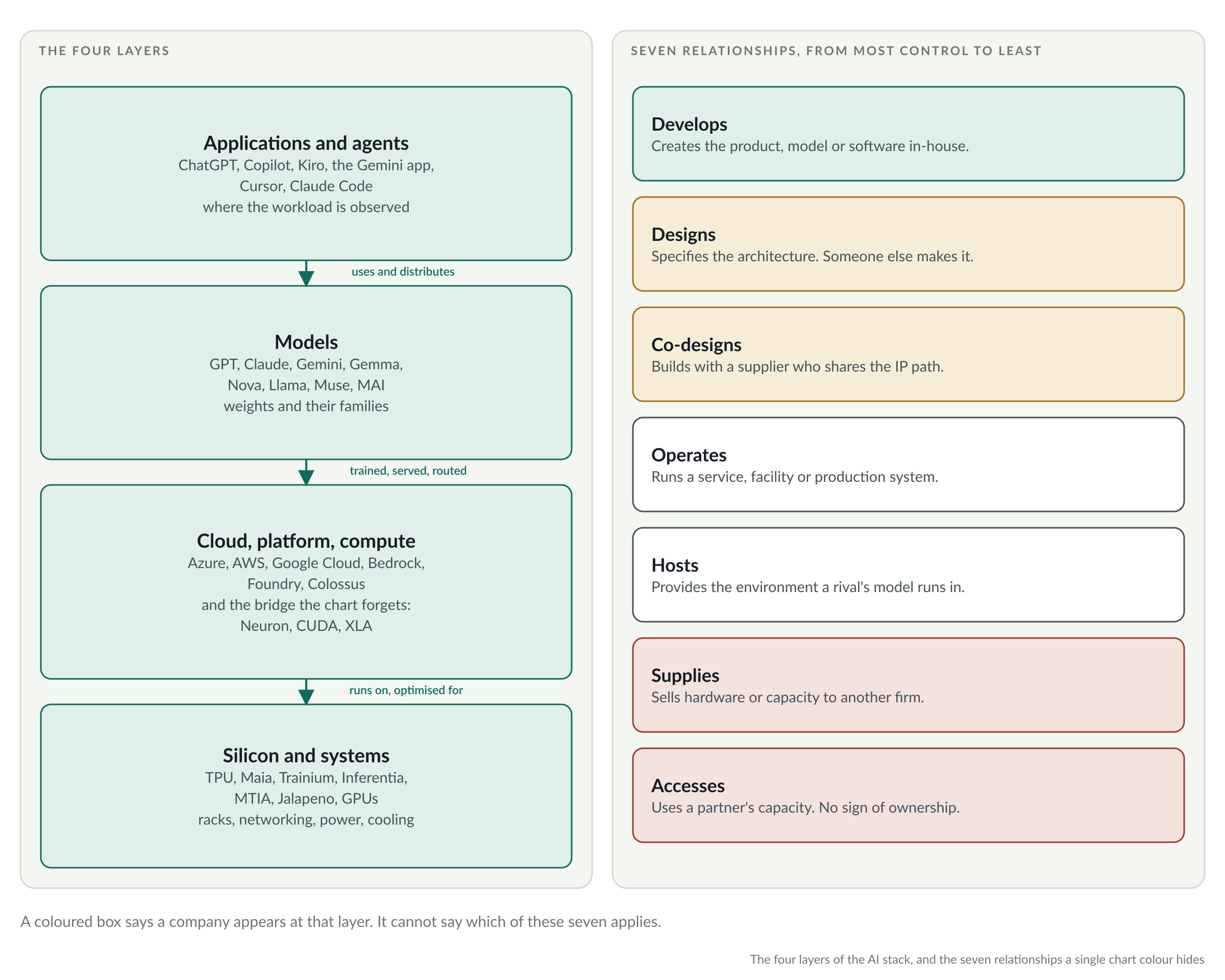
There are at least seven relationships a company can have with a layer, and they are nowhere near equivalent. It can develop the thing in-house. It can design it and have someone else fabricate it. It can co-design it with a strategic supplier. It can operate a facility, host a rival's model, supply hardware to a competitor, or simply access capacity it does not own.
Microsoft designed Maia 200. TSMC fabricates it at 3 nm and SK hynix supplies the memory.2 On the chart that is one box at the silicon layer. In reality it is a design relationship resting on two supply relationships, in an industry where fabrication capacity is the binding constraint. Those are not the same fact, and a board paper that treats them as one will reach the wrong conclusion.
The chart also drops the layer that makes any of it work. Between a model and an accelerator sit a compiler, a runtime and a set of kernels. AWS Neuron. NVIDIA CUDA. Google XLA. That software bridge is where lock-in actually lives, and it appears nowhere on the image.
What the verification found
Three facts came back that the chart cannot express. Each one inverts its thesis.
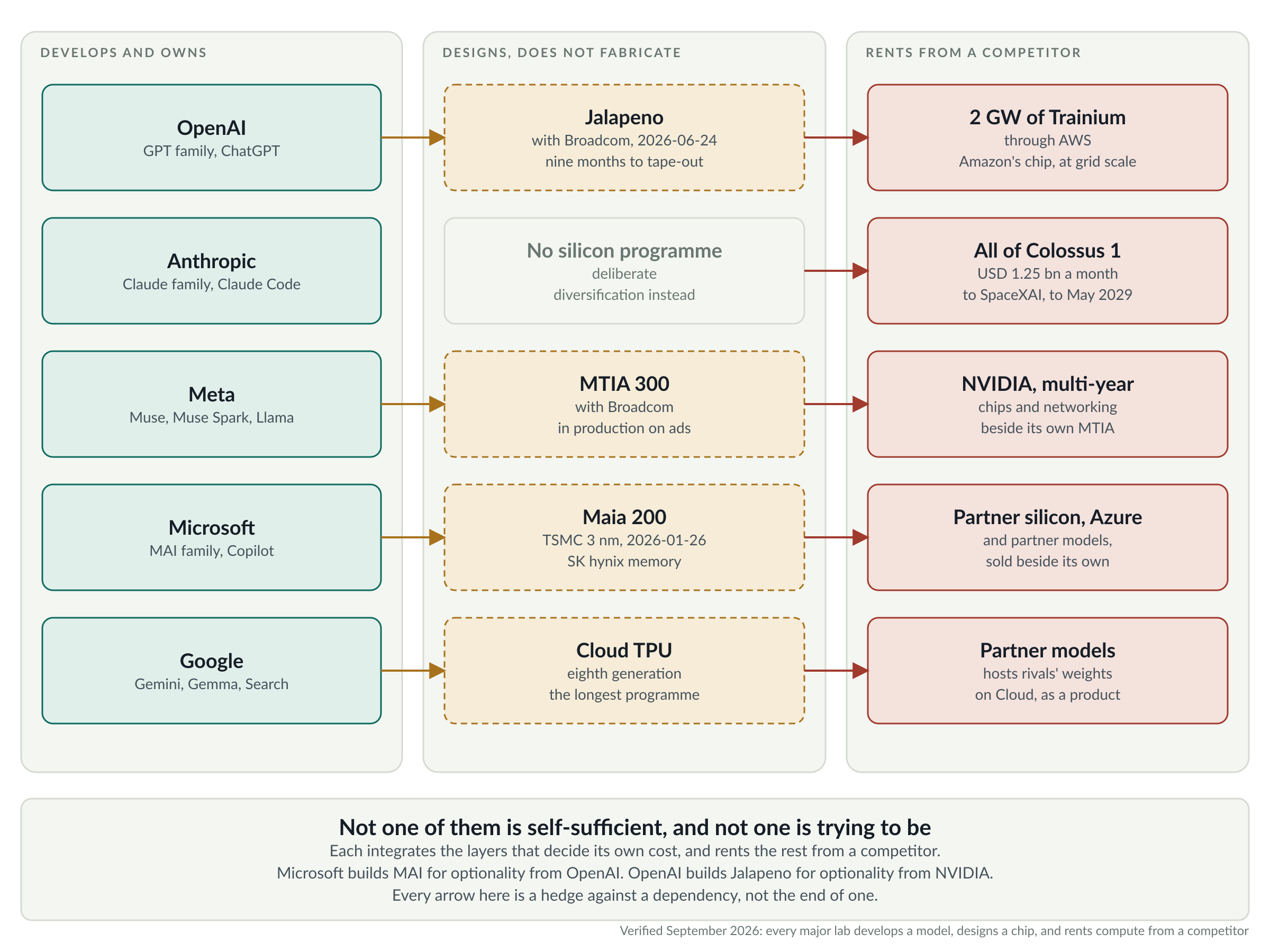
OpenAI will consume two gigawatts of Trainium capacity through AWS. The company that unveiled its own inference accelerator in June, named Jalapeño and co-designed with Broadcom in a nine-month cycle, is simultaneously committing to Amazon's accelerator at national-grid scale.34 Both things are true at once. The chip programme is a hedge against NVIDIA. It is not an exit from dependence.
Anthropic pays SpaceXAI 1.25 billion dollars a month, through May 2029. The May agreement takes all of Colossus 1's capacity, over 300 megawatts.56 Anthropic also names AWS its primary training partner, runs on Trainium, and has expanded onto Google Cloud TPUs. It owns the model layer outright and owns essentially none of the compute beneath it. That is deliberate diversification, and it is the clearest demonstration available that compute access is a lease, not a holding.
Microsoft and OpenAI are each integrating to escape the other's gravity. Microsoft shipped seven first-party MAI models at Build in June and framed them, in its own words, as optionality beside OpenAI.7 OpenAI designed Jalapeño for optionality beside NVIDIA. Meta runs MTIA 300 in production and signed a multi-year NVIDIA agreement in the same period.8
Read together the pattern is unmistakable. Every arrow on that page is a hedge against a dependency, not the end of one. Not one of these companies is self-sufficient. More to the point, not one of them is trying to be. Genuine self-sufficiency would mean owning fabrication, packaging, power, networking, facilities and distribution. Nobody is attempting that, because at current capital intensity it would be irrational.
The dates moved under the chart
A stack diagram is a photograph, not a map.
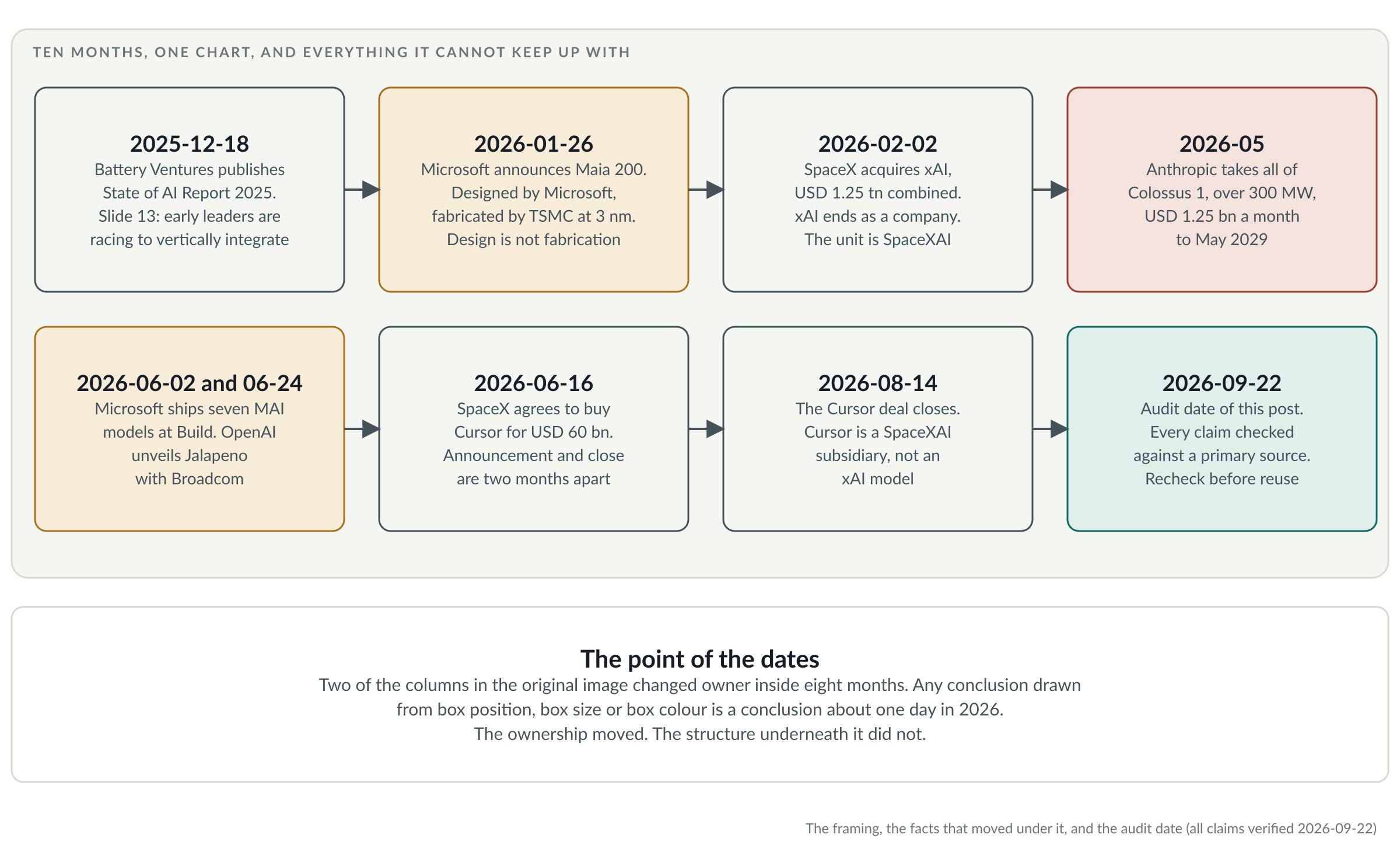
In the eight months after Battery published, two columns in that image changed hands. SpaceX acquired xAI on 2 February and xAI ceased to exist as a separate company.9 SpaceX agreed to buy Cursor on 16 June and closed on 14 August; Cursor is now a SpaceXAI subsidiary.10 The circulating chart still groups Cursor with Grok as though they were one model line.
This is not pedantry about labels. If the ownership of two columns can move inside eight months, any conclusion you draw from box position, box size or box colour is a conclusion about one particular day.
For anyone about to cite the image in a board paper, it establishes none of the following. Not market share, because box size has no denominator. Not ownership, because a supplier or a host is not an owner. Not exclusivity, because a company can run a chip programme and buy GPUs at the same time, and most do. Not performance, because appearing at a layer is not benchmark leadership. Not a durable moat, because the chart tests no switching cost, no margin and no return on capital. And not manufacturing control, because designing an accelerator and fabricating a wafer are different industries.
The honest summary is one sentence. Early AI leaders are integrating the layers that matter most to their own workloads, and preserving partnerships wherever ownership would be slower, costlier or less flexible.
The question the chart cannot ask
Here is what struck me hardest reading the verified version.
Every integration on that page reduces the vendor's dependency. Not one of them reduces yours.
When Microsoft designs Maia to cut its own inference cost, that gain is Microsoft's. When OpenAI ships Jalapeño to loosen NVIDIA's grip, that freedom is OpenAI's. When Google fuses Search, Gemini, Cloud and TPU into one operating environment, the coordination advantage belongs to Google.
For the institution buying the result, each of those fusions does the opposite. Every layer they weld together is one more layer you cannot substitute. The integration is real, the engineering is excellent, and the switching cost it creates lands entirely on your side of the invoice.
So the useful question is not who owns the whole stack. It is this.
Which side of the boundary is the integration happening on?
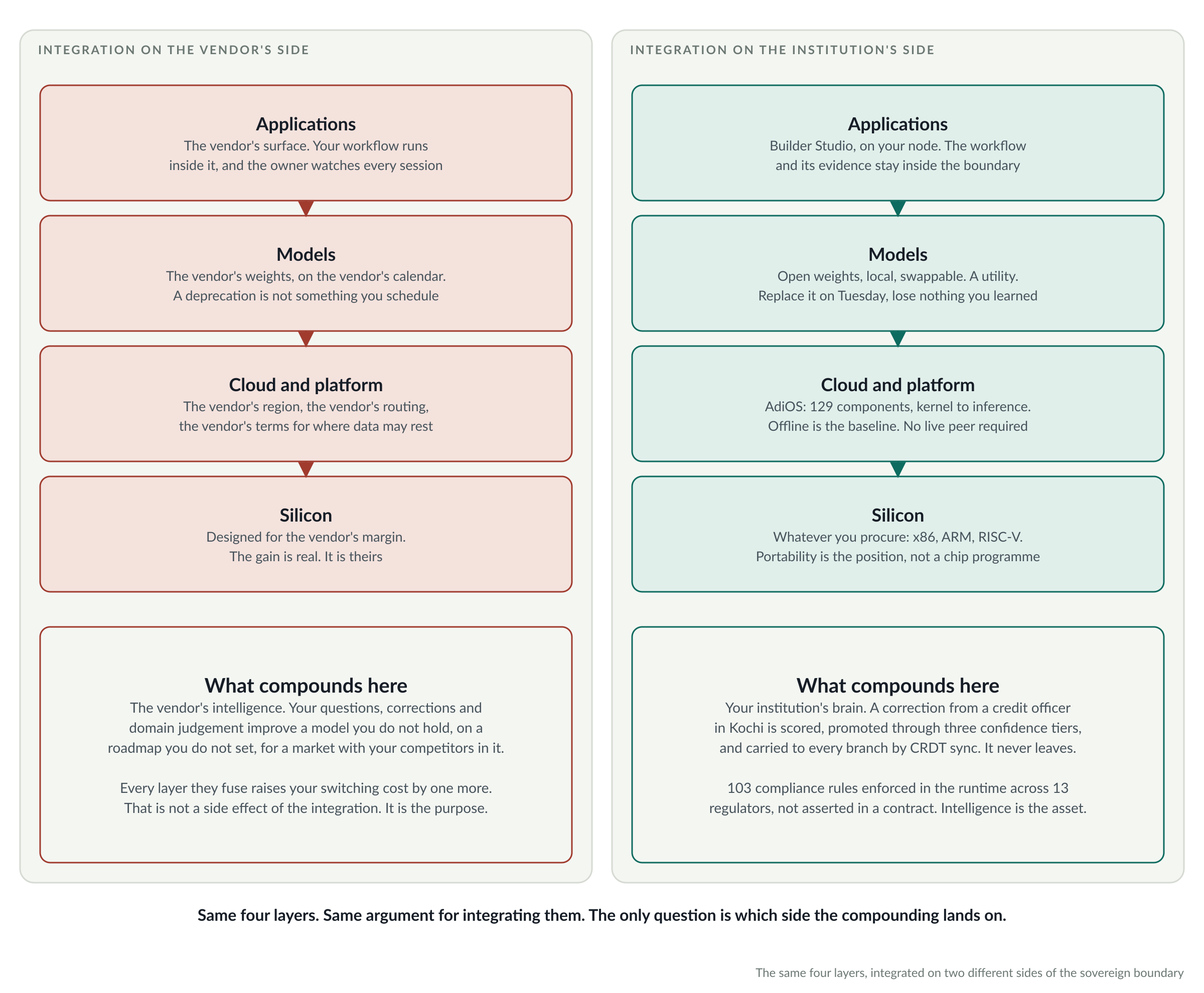
This is the reason AdiOS exists, and it deserves stating precisely, because precision is the point of this post.
AdiOS is the sovereign AI Operating System architected after the human brain, where intelligence compounds inside the institution that generates it, never resets, never leaves the boundary, and enforces compliance structurally at the OS layer rather than the application layer. It is one Rust estate of 129 components, from kernel to inference to interface, 540,511 lines of first-party code, running on hardware a bank or a ministry procures and controls.
We made the same vertical-integration bet the companies in that chart made. We made it on the other side of the boundary.
We do not build a frontier model, and that is the position rather than a gap. The model is a utility: open weights, running locally, swappable on a Tuesday. Competing at the frontier layer would be the least defensible thing a sovereign platform could do, because the frontier resets every six months and someone else pays to reset it.
What does not reset is the institution's own brain. A credit officer in Kochi corrects a risk assessment. That correction is scored, then promoted through three confidence tiers that live in the code rather than in a brochure: 0.70 for personal, 0.85 for domain with two stewards, 0.95 for enterprise with two curators. Then it is carried to every other branch by CRDT sync, where offline is the baseline and no operation requires a live peer. Change the model underneath and the institution loses nothing it learned.
Beneath that sit 103 compliance rules enforced in the runtime across 13 regulators, alongside 397 documented frameworks. Enforced means a test fails, not that a policy document exists.
I will be equally precise about what is not finished. Our policy ring currently runs at an in-process trust floor. It is real, it is gated in continuous integration across all four rollout phases, and it is bypassable from a compromised userspace. Moving it to the OS layer with a hardware signing root is work scheduled for the first quarter of 2027. I would rather write that sentence than let a diagram imply otherwise. That is the same discipline this whole post is arguing for.
From ownership to compounding
The chart points at something real. Competition has moved from a single layer to the whole path from workflow to model to compute to silicon. Coordination across those layers is a genuine advantage and the firms pursuing it are not wrong to.
But the winning structure is not a self-sufficient company. It is selective integration inside a dense network of suppliers and partners, and the verified record for September 2026 shows it plainly. OpenAI rents from Amazon. Anthropic rents from Musk. Microsoft hedges against OpenAI. Meta buys NVIDIA while shipping MTIA. They are all integrating, they are all dependent, and both facts are load-bearing.
Which leaves the question that actually decides where your institution stands in ten years. Not who owns the stack.
Who owns what compounds.
If you are making that call for a bank, a ministry or a manufacturer, talk to us.
A note on the source image
The circulating chart adapts slide 13 of Battery Ventures' State of AI Report 2025 and carries a signature identifying Lin, @Speculator_io. The exact original post and the extent of adaptation were not independently verified. Battery states that the presentation contains proprietary information and no permissive licence was found, so this post reproduces neither the circulated image nor Battery's slide. Every diagram above is original AdiOS work.
Two errors in the version we reviewed were corrected before publishing. The Cursor acquisition was announced on 16 June 2026 and closed on 14 August, not announced in August. And Celestica's participation in the Jalapeño programme could not be confirmed in any reviewed source, so only Broadcom is named.
Audit date: 22 September 2026. Ownership in this sector moves fast enough that any claim above may be stale. Check before you reuse it.
References
- Battery Ventures (2025). It's Here: The AI Supercycle Has Arrived, and the accompanying State of AI Report 2025, published 18 December 2025.
- Microsoft (2026). Maia 200: The AI accelerator built for inference, 26 January 2026.
- OpenAI and Broadcom (2026). OpenAI and Broadcom unveil LLM-optimized inference chip, 24 June 2026.
- Amazon Web Services. AWS Trainium and AWS Neuron.
- Anthropic (2026). Higher usage limits and a SpaceX compute deal, May 2026.
- SpaceXAI (2026). New compute partnership with Anthropic, May 2026.
- Microsoft AI (2026). New MAI models available in Foundry, announced at Build, 2 June 2026.
- Meta (2026). Introducing Muse Spark from Meta Superintelligence Labs, April 2026.
- SpaceX (2026). xAI joins SpaceX, 2 February 2026.
- Cursor (2026). Cursor is joining SpaceX, 16 June 2026; the transaction closed 14 August 2026.
- UK Competition and Markets Authority. AI Foundation Models Update Paper.
- US Federal Trade Commission (2025). Behind the FTC's 6(b) report on large AI partnerships and investments.